
• Home
  • Platform
    • Platform Capabilities
    • Integrations
    • Intelligent Workflows
    • Multi Cloud Cost
    • Policy Engine
    • Cost Allocation
    • Billing Analysis
    • Rightsizing
    • Dashboards & Reports

      Platform Capabilities

      Full-stack cloud control layer

      Integrations

      Connect 200+ cloud services

      Intelligent Workflows

      Event-driven task scheduling

      Multi Cloud Cost

      Unified cost visibility

      Policy Engine

      Compliance at enterprise scale

      Cost Allocation

      Tag-based allocation & chargeback

      Billing Analysis

      Deep-dive usage anomalies

      Rightsizing

      AI-powered resource sizing

      Dashboards & Reports

      Real-time custom reporting

      Platform Preview

      CloudPi Platform

      Govern and optimize multi-cloud spending with absolute precision using neural anomaly calculations.

      Cost Optimization +40% ROI
      Security Score 99.9%
      Explore Platform
  • Solutions
    • Solutions by Role
    • Solutions by Persona
    • Why CloudPi

      Solutions by Role

      Custom tools designed for FinOps, Engineering, and Finance.

      Solutions by Persona

      Aligned with executives, managers, and system operators.

      Why CloudPi

      Four core challenges, four answers, one governed system.

      Core Outcomes

      Solutions Value

      Empower your finance, engineering, and FinOps teams to govern cloud operations collaboratively with absolute precision.

      Cost Efficiency Boost +55% Savings
      Time-to-Value Instant Day-1
      Explore Solutions
  • Company
    • About
    • Book Demo
    • Security
    • Features

      About Us

      Our mission, vision & core team.

      Book Demo

      Schedule a custom walkthrough.

      Security

      Zero-trust enterprise protection.

      Features

      Deep dive platform capabilities.

      Trust & Uptime

      About CloudPi

      We are building the future of autonomous cost optimization to help modern enterprise cloud control rooms run efficiently.

      Enterprise Trust Score 100% Secure
      Standard SLA 99.99%
      Learn More
  • Pricing
  • Resources
    • Documentation
    • FAQ
    • Videos
    • AWS S3 Cost Surge
    • Freight Manufacturer
    • API Cost Tracking

      Documentation

      User guides, configurations, and reference manuals.

      FAQ

      Frequently asked questions and support notes.

      Videos

      Walkthroughs, demos, and feature highlight videos.

      Case Studies

      Real-world cloud cost optimization outcomes and client stories.

      Resources Hub

      Learn & Grow

      Explore our collection of detailed guides, video walkthroughs, and case studies to supercharge cost controls.

      Guides & Tutorials 50+ Articles
      Demo Video Views 10K+ Watched
      Visit Learn Center
BOOK DEMO
HomeCloud Cost Optimization What Is Cloud Tag Management and Why Does It Matter for Your Budget?

What Is Cloud Tag Management and Why Does It Matter for Your Budget?

CloudPi-Blogs on August 10, 2026
Cloud Cost Optimization
cloud tag management
5 Min Read

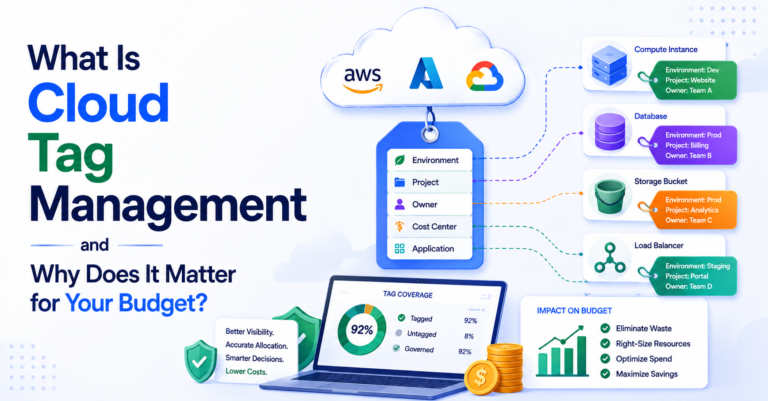
Cloud tag management is the practice of applying, enforcing, and maintaining consistent metadata — owner, environment, cost center, project — on every cloud resource, and it’s the foundation everything else in FinOps depends on. Ask a platform team what percentage of their cloud resources are properly tagged, and the honest answer at most companies is somewhere between “we’re not sure” and “worse than we’d like.” That uncertainty isn’t a minor housekeeping gap — it’s the reason cost allocation reports don’t add up, rightsizing recommendations get ignored because nobody can confirm ownership, and budget alerts fire against the wrong team.

Table of Contents

  • Why Cloud Tag Management Is a Budget Problem, Not Just a Housekeeping One
  • What Good Cloud Tag Management Looks Like
  • The Untagged Cloud Resources Retrofitting Problem
  • Automating What Manual Cloud Tag Management Can’t Sustain
  • Frequently Asked Questions

    Why Cloud Tag Management Is a Budget Problem, Not Just a Housekeeping One

    Every cost allocation decision — who owns this spend, is this environment over budget, should this resource be flagged as idle — depends on being able to attribute a resource to an owner. Without consistent tags:

    • Cost reports become estimates, not facts. If 20% of resources are untagged, 20% of spend sits in an “unallocated” bucket that nobody is accountable for.
    • Chargeback and showback break down. You can’t charge a team for spend you can’t attribute to them, which means untagged cloud resources effectively become free to whoever created them. See cloud chargeback vs showback for how directly both models depend on this.
    • Automated cost optimization has no owner to notify. A rightsizing recommendation on an untagged resource has nowhere to go — nobody gets the alert, so nobody acts on it.

    What Good Cloud Tag Management Looks Like

    PracticeWhat it meansWhy it matters
    A defined, minimal cloud tagging taxonomyFour to six required tags — owner, team, environment, cost center, projectEnough to answer the questions that matter, not so many that compliance becomes a burden
    Policy as code tagging enforcementBlocks or flags untagged resource creation automaticallyCatches the problem before it accumulates, instead of an archaeology project six months later
    Consistency across providersAWS tags, Azure tags, GCP labels normalized to one taxonomyA practice that only works within one provider’s conventions breaks down the moment you manage more than one
    Regular tag coverage compliance reportingTracked as a percentage, visible to the teams responsibleTurns tagging from a one-time cleanup project into an ongoing metric teams can actually improve against

    The Untagged Cloud Resources Retrofitting Problem

    Most companies don’t start with good cloud tag management — they retrofit it onto an environment that’s already grown organically for years. Retrofitting is harder than starting clean, but it’s not optional: every month spent with poor tag coverage compliance is another month of cost data that can’t be trusted for allocation, budgeting, or optimization decisions.

    The practical approach to retrofitting: enforce tagging on all new resources immediately, then work backward through existing untagged cloud resources by cost impact — tag the highest-spend untagged resources first, since that’s where the accuracy gap costs the most. For the broader guardrail system this fits inside, see the cloud governance framework, and if you’re managing this across more than one provider, see multi-cloud governance guide and multi-cloud vs single cloud for how tagging complexity factors into that decision.

    Automating What Manual Cloud Tag Management Can’t Sustain

    Manual tag audits don’t scale past a few hundred resources, and they’re stale the moment they’re finished. CloudPi, a multi-cloud cost management and governance platform, tracks tag coverage continuously across AWS, Azure, and GCP, flags untagged or inconsistently tagged resources as they appear, and ties that coverage directly into cost allocation — so your budget numbers are only as reliable as your tags, and your tags are finally something you can trust.

    Frequently Asked Questions

    What is cloud tag management?

    The practice of applying, enforcing, and maintaining consistent metadata — owner, environment, cost center, project — on every cloud resource, so spend can be reliably attributed to the team or service responsible for it.

    Why does cloud tag management matter for budgeting?

    Because cost reports, chargeback, showback, and automated rightsizing recommendations all depend on knowing who owns a resource. Without it, untagged spend sits in an unallocated bucket nobody is accountable for.

    How many tags should a cloud tagging taxonomy require?

    Usually four to six: owner, team, environment, cost center, and project. A working taxonomy is deliberately minimal — enough to answer the questions that matter without making compliance a burden nobody follows.

    Should tagging be enforced automatically or checked during audits?

    Enforced automatically, using policy as code that blocks or flags untagged resource creation at the moment it happens. Catching it at audit time means finding a large backlog of untagged resources with no record of who created them.

    What’s the best way to retrofit tagging onto an existing cloud environment?

    Enforce tagging on all new resources immediately, then work backward through existing untagged resources ordered by cost impact — tagging the highest-spend resources first, since that’s where the accuracy gap costs the most.

    CloudPi-Blogs on August 10, 2026 Cloud Cost Optimization
    previous article
    Next article

    Leave a comment Cancel reply

    Your email address will not be published. Required fields are marked *

    About CLOUDPI

    CloudPi Editorial Team

    Cloud Cost Optimization & FinOps Specialists

    Expert insights on FinOps, cloud cost optimization, governance, and automation for modern cloud teams.

    • X
    • Instagram
    • LinkedIn
    • YouTube

    FEATURED POSTS

    categories

    • AWS 3
    • Blog 8
    • Cloud Cost Optimization 40
    • CloudPi 12

    related articles

    • Databricks cost calculator
      Databricks Cost Calculator Guide: DBU Pricing & OptimizationAugust 12, 2026
    • automate cloud policy enforcement
      How to Automate Cloud Policy Enforcement Across AWS, Azure, and GCPAugust 11, 2026
    • cloud tag management
      What Is Cloud Tag Management and Why Does It Matter for Your Budget?August 10, 2026

    popular tags

    Cloud Cost Management Cloud Cost Optimization CloudCostOptimization CloudCostSavings CloudEfficiency CloudManagement CloudOptimization CloudPi CloudSavings CloudSolutions Multi-Cloud Management

    CloudPi helps organizations gain visibility into multi-cloud spending, optimize infrastructure costs, and enforce governance across AWS, Azure, and Google Cloud environments.

    AvailableInMarket-AWS-DUHaQVhh

    Stay ahead of cloud cost optimization trends.

    PLATFORM
    • Platform Capabilities
    • Integrations
    • Intelligent Workflows
    • Cloud Cost Analytics
    • Policy Engine
    • Pricing
    COMPANY
    • About Us
    • Features
    • Contact Us
    • Careers
    • Security
    • Privacy Policy
    • Terms of Service
    RESOURCES
    • User Guide
    • Press Releases
    • FAQ
    • Case Studies
    • Blogs
    • Events
    • Webinars

    categories

    • vs. Finout
    • vs. CloudZero
    • vs. Apptio Cloudability
    • vs. PointFive
    • vs. ProsperOps
    • vs. Harness

    © 2026 CloudPi. All rights reserved.

    Back to top