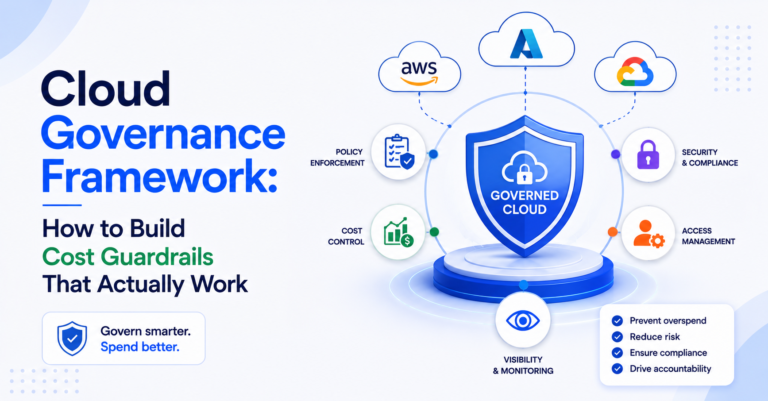
A real cloud governance framework isn’t a policy document — it’s automated enforcement at the moment a decision gets made. A governance policy that lives in a Confluence page has a predictable lifecycle: it gets written after an incident, read during onboarding, and ignored under deadline pressure six months later. The engineer provisioning a resource at 6 PM before a launch isn’t going to stop and check a wiki. Guardrails that actually work aren’t documented — they’re enforced automatically.
Table of Contents
Why “Policy Documents” Aren’t a Cloud Governance Framework
A framework that depends on people remembering rules isn’t a governance framework — it’s a hope. Real cloud governance frameworks have three properties a wiki page doesn’t:
- Automated enforcement, so non-compliant actions are blocked or flagged at creation time, not discovered in a quarterly audit.
- Consistent application across cloud providers, so the rule works the same way whether the resource is in AWS, Azure, or GCP.
- Visibility into compliance state at any time, not just when someone runs a manual check.
The Four Guardrail Categories Every Cloud Governance Framework Needs
| Guardrail type | What it enforces | Why it matters |
|---|---|---|
| Tagging guardrails | Owner, environment, and cost-center tags required at resource creation; non-compliant resources blocked or flagged | Highest-leverage guardrail — cost allocation, budget alerts, and security review all depend on knowing who owns what |
| Budget guardrails | Spend thresholds per team, environment, or project, with alerts before a hard limit | Gives teams time to act instead of finding out from a blocked deployment |
| Resource guardrails | Restricted instance types, regions, or services to an approved list | Prevents an engineer from spinning up an expensive, unapproved resource type on a whim |
| Lifecycle guardrails | Automatic cleanup for temporary resources — dev environments, test data, snapshots | Stops “temporary” from quietly becoming “permanent and billing” |
Building a Cloud Governance Framework in Practice
- Start with tagging guardrails. Nothing else in the framework works reliably without it, so it’s the correct first investment even though it feels like the least exciting guardrail.
- Add budget guardrails before hard spend limits. Hard limits that block deployment can create outages if set incorrectly; alerts that give teams warning are lower-risk to roll out first and build trust in the system.
- Layer in resource guardrails only where there’s a clear compliance or cost driver. Overly restrictive guardrails without a clear reason train engineers to route around governance instead of working with it.
- Make compliance state visible to the teams it applies to, not just to a central governance team. A team that can see their own tagging compliance percentage fixes it faster than one that finds out during an annual audit.
For how this fits into a broader multi-provider setup, see the multi-cloud governance guide, and for the tagging discipline this framework depends on, see the cloud cost optimization checklist.
The Guardrail That Fails Most Often: Inconsistency Across Clouds
The most common cloud governance framework failure isn’t a missing policy — it’s a policy that exists in AWS Organizations but was never replicated in Azure Policy or GCP Organization Policy. Each provider’s native governance tools only govern that provider. A framework that only covers your primary cloud leaves the newer or smaller cloud footprint completely ungoverned, which is often where the most risk accumulates precisely because it gets the least attention. If you’re still deciding whether to run multi-cloud in the first place, see multi-cloud vs single cloud — governance complexity is a real part of that decision.
Cloud Governance Automation Is What Closes the Gap
The gap between “we have a governance framework” and “our governance framework actually works” is cloud governance automation. CloudPi’s Policy Hub, part of CloudPi’s multi-cloud cost management and governance platform, enforces tagging, budget, and resource guardrails consistently across AWS, Azure, and GCP — so governance isn’t a document engineers are supposed to remember, it’s a system that catches non-compliance the moment it happens.
Frequently Asked Questions
What is a cloud governance framework?
The set of policies, controls, and automated enforcement mechanisms — tagging, budget, resource, and lifecycle guardrails — that keep cost, security, and compliance consistent across cloud providers, rather than relying on documentation people are supposed to remember.
Why don’t policy documents work as cloud governance?
Because they depend on people remembering and following rules under deadline pressure, with no automated check at the moment a decision is made — real governance requires automated enforcement, not documentation.
What guardrail should a cloud governance framework start with?
Tagging guardrails. Nothing else in the framework — cost allocation, budget alerts, security review — works reliably without accurate tagging in place first.
Should budget guardrails block deployments or just send alerts?
Start with alerts before hard limits. Hard limits that block deployment can cause outages if configured incorrectly, so alerts that give teams warning time are lower-risk to roll out first and build trust in the system.
Why does cloud governance framework consistency across providers matter so much?
Because native governance tools like AWS Organizations, Azure Policy, and GCP Organization Policy only govern their own provider — a framework that only covers the primary cloud leaves the newer or smaller footprint completely ungoverned, which is often where the most risk accumulates.