
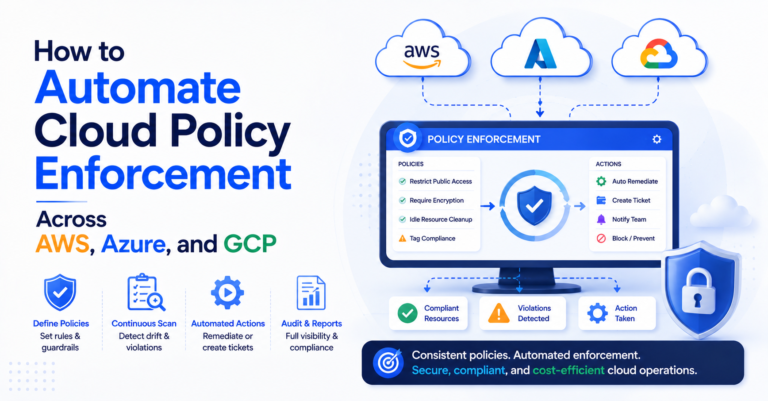
To automate cloud policy enforcement, policy has to be evaluated at the moment a resource is created, not audited after the fact. A policy that says “all S3 buckets must be private by default” is worth nothing if it only lives in a security runbook. The bucket that gets created at 11 PM before a demo, by an engineer who’s never read the runbook, is the one that ends up public. Policy enforcement only works when it’s automated into the resource creation path itself — not documented somewhere and hoped for.
Table of Contents
Why Manual Enforcement Doesn’t Scale
The traditional model — write a policy, communicate it, audit compliance periodically — fails for a structural reason: cloud resources get created continuously, by dozens or hundreds of engineers, faster than any manual review process can keep pace with. By the time a quarterly audit finds a non-compliant resource, it’s been running out of compliance for up to three months. To automate cloud policy enforcement is to flip that model: instead of checking compliance after creation, it evaluates the policy at the moment of creation and blocks, flags, or auto-remediates before non-compliance ever goes live.
Policy as Code: The Foundation to Automate Cloud Policy Enforcement
Automated enforcement requires expressing policy as code that can be evaluated programmatically, rather than as prose in a document. This is what makes cross-cloud consistency possible — the same logical policy (“resources must be tagged,” “no public storage buckets in production”) can be implemented once and evaluated against AWS, Azure, and GCP resources using each provider’s native policy engine, or a unified layer above all three.
| Provider | Native policy-as-code approach |
|---|---|
| AWS | Service Control Policies (SCPs) and AWS Config Rules for account-level and resource-level enforcement |
| Azure | Azure Policy enforcement, which can audit, deny, or auto-remediate non-compliant resources |
| GCP | Organization Policy Constraints for account-level restrictions, plus Config Validator for more granular checks |
The challenge isn’t implementing policy as code within one provider — each one has mature tooling for that. The challenge is maintaining equivalent policies across all three without cross-cloud policy drift as each gets updated independently by different teams.
Three Policy Enforcement Modes, and When to Use Each
| Mode | What it does | When to use it |
|---|---|---|
| Audit mode | Flags non-compliant resources without blocking them | Rolling out a new policy, to understand its impact before it can break a deployment |
| Deny mode | Blocks non-compliant resource creation outright | When the risk of a violation (like a public database) outweighs the risk of blocking a legitimate deployment |
| Auto-remediate mode | Automatically fixes non-compliance after the fact | Sparingly, for low-risk, well-understood policies only — remediating the wrong policy can cause its own outages |
Most mature governance programs start every new policy in audit mode, move to deny mode once false positives are tuned out, and reserve auto-remediation for a small set of well-tested, low-risk cases. For the broader guardrail categories these enforcement modes apply to, see the cloud governance framework, and for why tagging is usually the first policy worth automating, see cloud tag management.
Where Attempts to Automate Cloud Policy Enforcement Break Down
The most common failure isn’t technical — it’s organizational. Policies get automated for the primary cloud provider (usually the one the platform team knows best) and never replicated for secondary providers, leaving governance gaps exactly where they’re least likely to be noticed — the same cross-cloud policy drift problem covered in the multi-cloud governance guide. The second most common failure is over-restrictive deny-mode policies rolled out without an audit period first, which trains engineers to find workarounds instead of building trust in the system. If you’re still weighing whether multi-provider policy complexity is worth taking on, see multi-cloud vs single cloud.
Enforcing Once, Applying Everywhere
Building and maintaining three separate policy-as-code implementations is real ongoing engineering work. CloudPi’s Policy Hub, part of CloudPi’s multi-cloud cost management and governance platform, lets you define policy once and enforce it consistently across AWS, Azure, and GCP — so automating cloud policy enforcement doesn’t mean maintaining three parallel systems that inevitably drift apart.
Frequently Asked Questions
How do you automate cloud policy enforcement?
By expressing policy as code that evaluates automatically at the moment a resource is created, using each provider’s native policy engine (or a unified layer above them), rather than relying on periodic manual audits of already-created resources.
What’s the difference between audit, deny, and auto-remediate enforcement modes?
Audit mode flags non-compliant resources without blocking them, deny mode blocks non-compliant resource creation outright, and auto-remediate mode automatically fixes non-compliance after the fact — most programs start new policies in audit mode and graduate to deny mode once false positives are tuned out.
Which native tools support policy as code on each cloud provider?
AWS uses Service Control Policies and Config Rules, Azure uses Azure Policy enforcement with audit, deny, or auto-remediate options, and GCP uses Organization Policy Constraints plus Config Validator for more granular checks.
Why does policy enforcement often work on one cloud but not others at the same company?
Because policies typically get automated first for the primary provider the platform team knows best, and are never replicated for secondary providers — creating cross-cloud policy drift and governance gaps exactly where they’re least likely to be noticed.
Should a new policy start in deny mode or audit mode?
Audit mode. Rolling out a new policy in audit mode first lets a team see its impact and tune out false positives before it can block a legitimate deployment; jumping straight to deny mode risks outages and erodes trust in the governance system.