Cloud compliance automation changes the audit conversation from “let us go verify” to “here’s the continuous compliance record,” and that shift matters more than most compliance programs give it credit for. The week before a SOC 2 audit shouldn’t involve a scramble to screenshot IAM policies, manually verify encryption settings across hundreds of resources, and hope nothing changed since the last review. But at companies where compliance is enforced through periodic manual checks instead of continuous automated policy, that scramble is exactly what audit prep looks like — every time.
Table of Contents
The Problem Cloud Compliance Automation Solves: Point-in-Time Checks
Traditional compliance checks are snapshots: an auditor or internal reviewer verifies a set of controls at a specific moment. The problem is cloud infrastructure changes continuously — a resource compliant during last quarter’s review can drift out of compliance the next day, and nobody notices until the next scheduled check, which might be months away. This creates two real risks:
- Undetected drift — a misconfigured resource sits non-compliant for months, increasing both security exposure and audit risk.
- Audit prep overhead — because compliance isn’t tracked continuously, verifying it for an audit becomes a manual project every time, consuming weeks of engineering and compliance team time that could go toward actual security work.
What Cloud Compliance Automation Actually Does
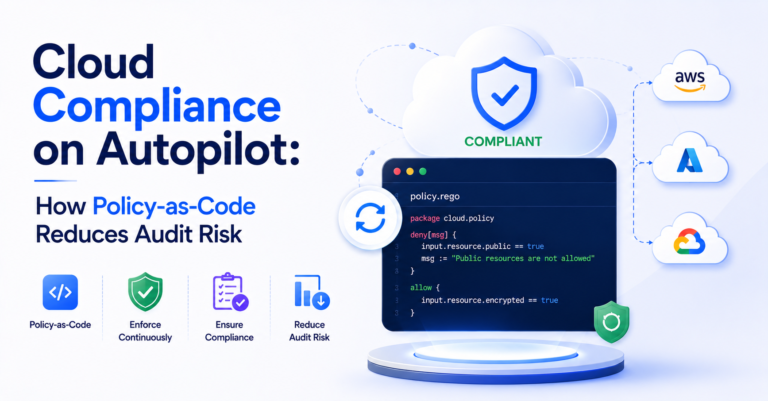
Policy-as-code compliance expresses requirements — encryption at rest, network access restrictions, logging retention, access control patterns — as code that can be evaluated automatically against every resource, continuously, rather than checked by a human on a schedule. This enables three capabilities manual compliance can’t match:
| Capability | What it replaces | Why it matters |
|---|---|---|
| Continuous compliance monitoring | Periodic, scheduled manual audits | Every resource is checked at creation and on an ongoing basis, not just when someone remembers to run a review |
| Compliance drift detection | Discovering drift at the next audit, months later | A security group opened too broadly or an encryption setting disabled gets flagged the same day, not the same quarter |
| Automatic audit trail | Manual evidence-gathering before every audit | Every compliance check, pass or fail, is logged with a timestamp automatically |
Common Compliance Frameworks Cloud Compliance Automation Applies To
Policy-as-code compliance isn’t tied to one framework — the same underlying enforcement mechanism supports evidence collection for SOC 2, HIPAA, PCI-DSS, and CIS Benchmarks. The specific controls differ by framework, but the pattern is identical: define the required configuration as code, evaluate continuously, log the result. For the broader guardrail categories this fits inside, see the cloud governance framework, and for the underlying enforcement mechanics, see automate cloud policy enforcement.
For multi-cloud organizations, this consistency matters even more — a framework’s requirements don’t change based on which cloud provider hosts the resource, so the policy logic shouldn’t need to be reimplemented three separate times to cover AWS, Azure, and GCP. See the multi-cloud governance guide for how that consistency gets structured across providers.
Where Cloud Compliance Automation Reduces Audit Risk Most
The highest-value automation targets are the controls most prone to silent drift: encryption settings that get disabled during a debugging session and never re-enabled, security groups temporarily opened for troubleshooting and left open, logging that gets disabled to reduce noise and never restored. None of these are malicious — they’re the natural byproduct of engineers moving fast under pressure. Compliance drift detection catches them within hours instead of at the next audit cycle. If you’re weighing whether multi-provider compliance complexity is worth taking on, see multi-cloud vs single cloud.
From Audit Scramble to Audit Confidence
CloudPi’s Policy Hub, part of CloudPi’s multi-cloud cost management and governance platform, continuously evaluates compliance-relevant configuration across AWS, Azure, and GCP, flags drift as it happens, and maintains the audit trail automatically — so the week before your next SOC 2 audit automation cycle looks like reviewing a report instead of assembling one from scratch.
Frequently Asked Questions
What is cloud compliance automation?
Using policy-as-code to continuously evaluate cloud resources against compliance requirements — encryption, access control, logging retention — instead of checking them manually at scheduled intervals, catching drift within hours rather than months.
Why is point-in-time compliance checking risky?
Because cloud infrastructure changes continuously — a resource compliant during last quarter’s review can drift out of compliance the next day, and nobody notices until the next scheduled check, which might be months away.
Which compliance frameworks does policy-as-code compliance work with?
It isn’t tied to one — the same enforcement mechanism supports evidence collection for SOC 2, HIPAA, PCI-DSS, and CIS Benchmarks. The specific controls differ by framework, but the pattern of continuous evaluation is identical across all of them.
What controls are most prone to silent compliance drift?
Encryption settings disabled during a debugging session and never re-enabled, security groups opened for troubleshooting and left open, and logging disabled to reduce noise and never restored — none malicious, all natural byproducts of engineers moving fast.
Does cloud compliance automation replace the need for SOC 2 audit automation prep entirely?
It removes the manual evidence-gathering scramble by maintaining a continuous, timestamped audit trail automatically — audit prep becomes reviewing an existing record instead of assembling one from scratch.