
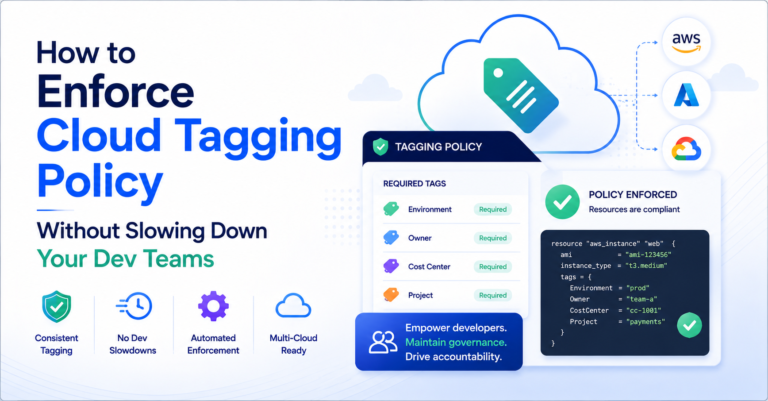
Good cloud tagging policy enforcement is invisible when it’s working and helpful when it isn’t – not a speed bump. The fastest way to make engineers hate a tagging policy is to make it a manual step that blocks a deployment with a cryptic error and no clear fix. The second fastest way is to make the policy so complex – twelve required tags, inconsistent naming rules, no defaults – that compliance itself becomes a bigger time sink than the resource provisioning it’s attached to. Both failure modes produce the same outcome: engineers route around the policy, and tag coverage stays low regardless of how strict the rule technically is.
Table of Contents
Why Cloud Tagging Policy Enforcement and Dev Velocity Feel Like They’re in Tension
Tagging enforcement gets a bad reputation because most implementations are built as a compliance gate rather than a workflow feature. An engineer provisioning a resource shouldn’t experience tagging as an extra form to fill out – it should be as close to automatic as possible, with policy stepping in only when something genuinely needs a human decision.
Four Ways to Enforce Cloud Tagging Policy Without Friction
| Approach | What it does | Why it works |
|---|---|---|
| Default tag inheritance | Most tag values inferred automatically – environment from the pipeline, team from the repository or IAM role, cost center from the project | Requiring engineers to manually type values the system already knows is friction with no benefit |
| Fail fast, with a clear fix | Error messages name exactly which tag is missing and how to add it | A generic violation code sends engineers to search a wiki; a clear fix keeps the policy from feeling like a blocker |
| Enforce at creation, not retroactively | Non-compliant resources blocked at the point of creation | Far less disruptive than finding thousands of untagged resources months later and retroactively assigning ownership |
| Audit mode before deny mode | New tagging requirements flagged, not blocked, at first | Surfaces false positives — cases where automatic tag inference doesn’t work — before the policy can block a real deployment |
Where Manual Tag Entry Is Still Necessary
Not every tag value can be inferred automatically. Cost center and project assignment sometimes require a genuine decision only the engineer can make, particularly for shared or cross-team resources. In these cases, the goal isn’t eliminating the manual step – it’s minimizing how often it’s required, by auto-populating everything that can be inferred and only prompting for what genuinely needs a human choice. For the broader tagging discipline this fits inside, see cloud tag management, and for the guardrail categories tagging enforcement belongs to, see the cloud governance framework.
Measuring Whether Cloud Tagging Policy Enforcement Is Actually Working
Well-designed cloud tagging policy enforcement should be measurable, not just felt. Track two numbers together: tag compliance rate and time-to-provision. If tag compliance rate goes up while provisioning time stays flat or improves, the enforcement is working as designed. If compliance rate improves but provisioning time increases significantly, the policy has become a bottleneck and needs to be reworked -usually by automating more of the tag inference rather than adding more manual required fields. This same audit mode rollout discipline applies to any automated governance control, not just tagging – see automate cloud policy enforcement for the broader pattern.
Cloud Tagging Policy Enforcement Across Multiple Providers
AWS tags, Azure tags, and GCP labels each use different syntax and defaults, which means automatic tag inference logic often needs to be reimplemented per provider unless it’s built on a normalized layer above all three. See the multi-cloud governance guide for how that consistency gets structured, and multi-cloud vs single cloud if you’re still weighing whether that added complexity is worth taking on.
Enforcement Built Into the Workflow, Not Bolted On
CloudPi, a multi-cloud cost management and governance platform, enforces cloud tagging policy across AWS, Azure, and GCP with automatic tag inference from deployment context, clear violation messaging, and audit-mode rollout support — so tag compliance rate improves without becoming the thing engineering complains about in the next retro.
Frequently Asked Questions
How do you enforce cloud tagging policy without slowing down engineers?
Effective cloud tagging policy enforcement relies on default tag inheritance that auto-populates most values from deployment context, fast and specific error messages when a tag is missing, enforcement at resource creation rather than retroactively, and rolling new requirements out in audit mode before deny mode.
What is default tag inheritance?
Automatically inferring tag values from context that already exists — environment from the deployment pipeline, team from the repository or IAM role provisioning the resource, cost center from the project — instead of requiring engineers to type in values the system already knows.
Why should new tagging policies start in audit mode instead of deny mode?
Because audit mode flags violations without blocking deployments, which surfaces false positives — cases where automatic tag inference doesn’t work correctly — before the policy can block a real, legitimate deployment.
How do you measure whether tagging policy enforcement is working well?
Track tag compliance rate and time-to-provision together. If compliance rises while provisioning time stays flat or improves, enforcement is working; if provisioning time increases significantly, the policy has become a bottleneck.
Can every tag value be automatically inferred?
No — cost center and project assignment sometimes require a genuine human decision, particularly for shared or cross-team resources. The goal is minimizing manual entry to only what truly needs a person, not eliminating it entirely.