
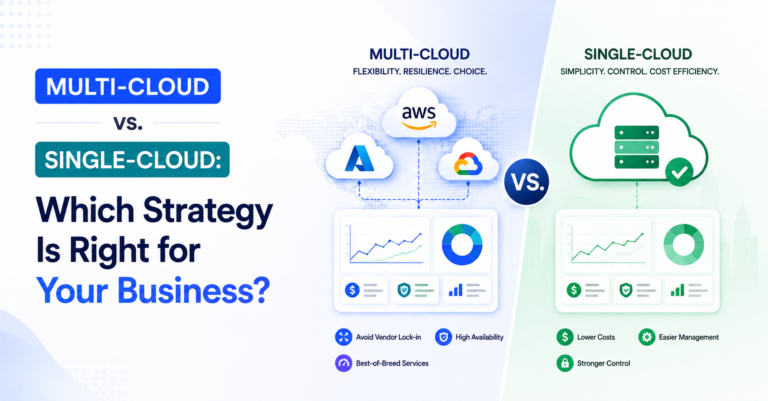
Multi-cloud vs single cloud isn’t a question with a universal answer — it’s a matter of matching the strategy to a specific, real constraint, not a general sophistication level. A single-cloud company gets acquired by a customer with a strict Azure-only procurement policy, and suddenly “just use AWS” isn’t a strategy anymore — it’s a blocker to closing deals. A multi-cloud company spends 18 months building duplicate tooling across three providers before realizing 80% of their workloads could have run on one cloud the whole time. Both are real failure modes, and the strategy that avoids them is the one grounded in constraints, not preference.
Table of Contents
Multi-Cloud vs Single Cloud: The Real Case for a Single-Cloud Strategy
Single-cloud isn’t the “less sophisticated” choice — for most companies below a certain scale, it’s the correct one.
| Advantage | Why it matters |
|---|---|
| Lower operational overhead | One provider means one set of APIs to learn, one billing model, one identity system, one support relationship. Engineering velocity is usually higher with less context-switching. |
| Deeper discount potential | Committed-use discounts and negotiated enterprise agreements scale with volume. Splitting spend across three providers means never hitting the volume tier that unlocks the best pricing on any of them. |
| Simpler governance and security | One provider’s IAM model, one set of compliance controls, one audit surface — multi-cloud governance is solvable, but it’s complexity single-cloud companies simply don’t need to solve. |
The honest reason most companies should default to a single-cloud strategy: multi-cloud complexity is a cost you pay whether or not you need the benefits it provides.
Multi-Cloud vs Single Cloud: The Real Case for a Multi-Cloud Strategy
Multi-cloud earns its complexity when it’s solving a specific, real constraint:
| Driver | What it looks like |
|---|---|
| Customer or regulatory requirements | Enterprise customers with vendor requirements, or regulated industries requiring geographic or provider diversity, sometimes make multi-cloud non-negotiable — one of the clearest cases where cloud vendor lock-in itself becomes the business risk. |
| Best-of-breed cloud services | Some workloads genuinely run better on a specific provider’s specialized service — GCP’s BigQuery for certain analytics workloads, for example. Multi-cloud lets you use the right tool without forcing every workload onto one provider’s weaker equivalent. |
| Resilience against provider-level outages | For businesses where cloud downtime has severe consequences, running critical paths across two providers can be legitimate risk mitigation — though it requires real architectural investment to do correctly, not just having accounts on two clouds. |
| M&A and inherited infrastructure | Companies that grow through acquisition often end up multi-cloud by inheritance rather than choice. The question shifts from “should we be multi-cloud” to “how do we manage what we already have.” |
The Question That Actually Decides Multi-Cloud vs Single Cloud
Don’t ask “is multi-cloud better than single-cloud” in the abstract. Ask: “does a specific business requirement force multi-cloud, and if so, can we manage the resulting complexity without it eating our engineering capacity?”
If the honest answer is no specific requirement forces it, a single-cloud strategy is very likely the right default — you can always add a second provider later for a specific workload without having built multi-cloud governance from day one. See the multi-cloud governance guide for what that governance layer actually requires once you do need it.
If the answer is yes, the strategy question shifts from “which cloud” to “how do we manage cost, security, and governance consistently across the clouds we’re now committed to” — which is the harder, more important question multi-cloud companies often underinvest in. See multi-cloud cost management for how that cost side plays out, and AWS vs Azure vs GCP cost if provider pricing itself is part of the decision.
Either Way, Visibility Comes First
Whether you land on single-cloud or multi-cloud, the decision should be based on real cost and usage data, not assumptions about provider pricing or capability. CloudPi, a multi-cloud cost management and governance platform, gives you that visibility from day one — tracking spend on whatever combination of AWS, Azure, and GCP you’re actually running, so the multi-cloud vs single cloud decision is grounded in your numbers, not a generic comparison.
Frequently Asked Questions
Is multi-cloud or single-cloud better for most businesses?
Neither is universally better — most companies below a certain scale should default to a single-cloud strategy unless a specific customer, regulatory, or best-of-breed requirement forces multi-cloud.
What are the main advantages of a single-cloud strategy?
Lower operational overhead from one set of APIs and one billing/identity system, deeper committed-use discounts from concentrated volume, and simpler governance and security with one provider’s IAM model and compliance controls.
When does multi-cloud actually make sense?
When a specific constraint forces it — customer or regulatory requirements, needing a best-of-breed cloud service only one provider offers well, resilience requirements against provider-level outages, or inherited multi-cloud infrastructure from an acquisition.
How should a company decide between multi-cloud vs single cloud?
By asking whether a specific business requirement forces multi-cloud, and whether the resulting complexity can be managed without eating engineering capacity — not by asking which approach sounds more sophisticated in the abstract.
Can a company add a second cloud provider later if they start single-cloud?
Yes — starting single-cloud doesn’t foreclose multi-cloud later. A specific workload can move to a second provider when a real requirement emerges, without having built full multi-cloud governance from day one.