
• Home
  • Platform
    • Platform Capabilities
    • Integrations
    • Intelligent Workflows
    • Multi Cloud Cost
    • Policy Engine
    • Cost Allocation
    • Billing Analysis
    • Rightsizing
    • Dashboards & Reports

      Platform Capabilities

      Full-stack cloud control layer

      Integrations

      Connect 200+ cloud services

      Intelligent Workflows

      Event-driven task scheduling

      Multi Cloud Cost

      Unified cost visibility

      Policy Engine

      Compliance at enterprise scale

      Cost Allocation

      Tag-based allocation & chargeback

      Billing Analysis

      Deep-dive usage anomalies

      Rightsizing

      AI-powered resource sizing

      Dashboards & Reports

      Real-time custom reporting

      Platform Preview

      CloudPi Platform

      Govern and optimize multi-cloud spending with absolute precision using neural anomaly calculations.

      Cost Optimization +40% ROI
      Security Score 99.9%
      Explore Platform
  • Solutions
    • Solutions by Role
    • Solutions by Persona
    • Why CloudPi

      Solutions by Role

      Custom tools designed for FinOps, Engineering, and Finance.

      Solutions by Persona

      Aligned with executives, managers, and system operators.

      Why CloudPi

      Four core challenges, four answers, one governed system.

      Core Outcomes

      Solutions Value

      Empower your finance, engineering, and FinOps teams to govern cloud operations collaboratively with absolute precision.

      Cost Efficiency Boost +55% Savings
      Time-to-Value Instant Day-1
      Explore Solutions
  • Company
    • About
    • Book Demo
    • Security
    • Features

      About Us

      Our mission, vision & core team.

      Book Demo

      Schedule a custom walkthrough.

      Security

      Zero-trust enterprise protection.

      Features

      Deep dive platform capabilities.

      Trust & Uptime

      About CloudPi

      We are building the future of autonomous cost optimization to help modern enterprise cloud control rooms run efficiently.

      Enterprise Trust Score 100% Secure
      Standard SLA 99.99%
      Learn More
  • Pricing
  • Resources
    • Documentation
    • FAQ
    • Videos
    • AWS S3 Cost Surge
    • Freight Manufacturer
    • API Cost Tracking

      Documentation

      User guides, configurations, and reference manuals.

      FAQ

      Frequently asked questions and support notes.

      Videos

      Walkthroughs, demos, and feature highlight videos.

      Case Studies

      Real-world cloud cost optimization outcomes and client stories.

      Resources Hub

      Learn & Grow

      Explore our collection of detailed guides, video walkthroughs, and case studies to supercharge cost controls.

      Guides & Tutorials 50+ Articles
      Demo Video Views 10K+ Watched
      Visit Learn Center
BOOK DEMO
HomeCloud Cost Optimization How to Get Unified Cloud Visibility Across AWS, Azure, and Google Cloud

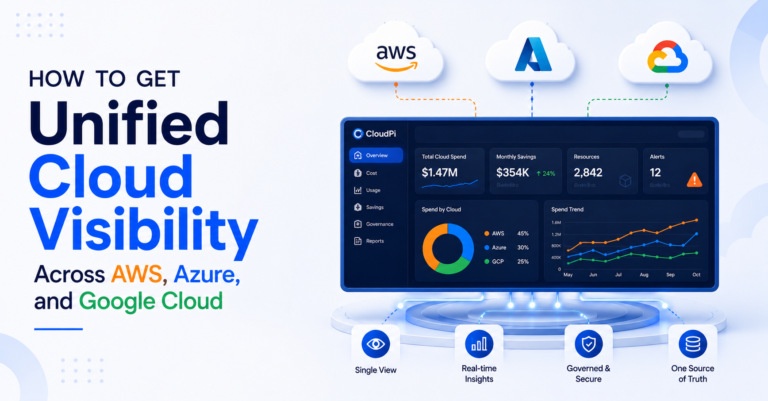
How to Get Unified Cloud Visibility Across AWS, Azure, and Google Cloud

CloudPi-Blogs on July 30, 2026
Cloud Cost Optimization
unified cloud visibility
5 Min Read

Unified cloud visibility means seeing spend, usage, and resource inventory across AWS, Azure, and GCP in one place, using one consistent taxonomy — not three provider views stitched together after the fact. Three browser tabs, three login sessions, three different definitions of what counts as a “cost center” — that’s what a Monday morning cost review looks like at most companies running multi-cloud without it. By the time someone manually reconciles AWS Cost Explorer, Azure Cost Management, and GCP’s Billing console into one spreadsheet, the data is already a week stale and half the context is lost in translation.

Table of Contents

  • Why Native Consoles Can’t Give You Unified Cloud Visibility
  • The Three Requirements for Real Unified Cloud Visibility
  • What Becomes Possible Once You Have Unified Cloud Visibility
  • Getting Unified Cloud Visibility Without a Multi-Quarter Data Engineering Project
  • Frequently Asked Questions

    Why Native Consoles Can’t Give You Unified Cloud Visibility

    Each provider’s billing console is built to answer questions about that provider. AWS Cost Explorer is excellent at explaining AWS spend. It has no concept of your Azure spend existing at all. This isn’t a feature gap you can configure around — it’s the fundamental design of a single-provider tool. Getting unified cloud visibility requires a layer above all three, not a better configuration of any one of them.

    The Three Requirements for Real Unified Cloud Visibility

    A common multi-cloud data model. AWS tags, Azure tags, and GCP labels use different syntax and different default conventions. Unified cloud visibility requires normalizing all three into one cloud cost taxonomy — the same “team,” “environment,” and “cost center” fields, regardless of which cloud generated the resource.

    Consistent time granularity. If AWS data updates daily but Azure data is pulled weekly, a “unified” view is really three views on different clocks stitched together. Real unification means every provider’s data refreshes on the same cadence.

    One place to ask cross-cloud questions. The real test of unified cloud visibility isn’t “can I see AWS spend and Azure spend on the same screen” — it’s “can I ask ‘what does the payments team spend across all three clouds combined’ and get an answer in one query.” That requires the underlying data to actually be joined, not just displayed side by side.

    What Becomes Possible Once You Have Unified Cloud Visibility

    Unified cloud visibility isn’t just a convenience — it unlocks decisions that are structurally impossible without it:

    • True total cost of ownership per team, not per cloud, so a team running services across two providers has one number to manage against.
    • Cross-cloud anomaly detection, catching a spend spike that’s small on each individual provider but significant in aggregate.
    • Apples-to-apples provider comparison for workload placement decisions, based on your actual usage patterns instead of list pricing — see AWS vs Azure vs GCP cost for how that comparison actually plays out by workload type.
    • One governance and tagging enforcement layer, instead of three separate policy implementations that drift out of sync — the same problem covered in the multi-cloud governance guide.

    Getting Unified Cloud Visibility Without a Multi-Quarter Data Engineering Project

    Building this internally means standing up ingestion pipelines for three separate billing APIs, normalizing the data models, and maintaining that pipeline as each provider changes their billing format — a real engineering investment most teams don’t have the bandwidth to sustain long-term. For the broader discipline this feeds into once the data exists, see multi-cloud cost management.

    CloudPi, a multi-cloud cost management and governance platform, does this natively: it ingests AWS, Azure, and GCP billing and usage data, normalizes it into one taxonomy, and refreshes it on a consistent schedule — so unified cloud visibility is a login, not a data engineering project.

    Frequently Asked Questions

    What is unified cloud visibility?

    Seeing spend, usage, and resource inventory across AWS, Azure, and GCP in one place, using one consistent taxonomy, rather than reconciling three separate provider consoles manually into a spreadsheet.

    Why can’t AWS Cost Explorer or Azure Cost Management provide unified cloud visibility on their own?

    Because each console is built to answer questions only about its own provider — AWS Cost Explorer has no concept of Azure spend existing at all, so unified visibility requires a layer above all three providers, not better configuration of any single one.

    What are the three requirements for real unified cloud visibility?

    A common data model that normalizes tags and labels across providers into one taxonomy, consistent time granularity so all providers’ data refreshes on the same cadence, and the ability to ask cross-cloud questions in a single query rather than viewing providers side by side.

    What decisions become possible with unified cloud visibility that aren’t possible otherwise?

    True total cost of ownership per team rather than per cloud, cross-cloud anomaly detection for spend spikes that are small individually but significant in aggregate, and apples-to-apples provider comparisons based on actual usage instead of list pricing.

    Can unified cloud visibility be built in-house, or does it require a dedicated tool?

    It can be built in-house, but it means standing up and maintaining ingestion pipelines for three separate billing APIs and normalizing their data models — an ongoing engineering investment most teams don’t have the bandwidth to sustain long-term compared to using a platform built for it.

    CloudPi-Blogs on July 30, 2026 Cloud Cost Optimization
    previous article

    Leave a comment Cancel reply

    Your email address will not be published. Required fields are marked *

    About CLOUDPI

    CloudPi Editorial Team

    Cloud Cost Optimization & FinOps Specialists

    Expert insights on FinOps, cloud cost optimization, governance, and automation for modern cloud teams.

    • X
    • Instagram
    • LinkedIn
    • YouTube

    FEATURED POSTS

    categories

    • AWS 3
    • Blog 6
    • Cloud Cost Optimization 35
    • CloudPi 10

    related articles

    • unified cloud visibility
      How to Get Unified Cloud Visibility Across AWS, Azure, and Google CloudJuly 30, 2026
    • multi-cloud governance guide
      The Ultimate Guide to Multi-Cloud Governance in 2026July 29, 2026
    • AWS vs Azure vs GCP cost
      AWS vs Azure vs GCP: Which Cloud Is Actually Cheaper for Your Workload?July 28, 2026

    popular tags

    Cloud Cost Management Cloud Cost Optimization CloudCostOptimization CloudCostSavings CloudEfficiency CloudManagement CloudOptimization CloudPi CloudSavings CloudSolutions Multi-Cloud Management

    Read next
    The Ultimate Guide to Multi-Cloud Governance in 2026 5 Min
    The Ultimate Guide to Multi-Cloud Governance in 2026
    CloudPi-Blogs on July 29, 2026
    This multi-cloud governance guide starts from one finding: without deliberate design, the default state isn’t...
    AWS vs Azure vs GCP: Which Cloud Is Actually Cheaper for Your Workload? 5 Min
    AWS vs Azure vs GCP: Which Cloud Is Actually Cheaper for Your Workload?
    CloudPi-Blogs on July 28, 2026
    “Which cloud is cheapest” is the wrong question for an AWS vs Azure vs GCP cost comparison, and...
    Maximize Your Cloud Savings with These Tagging Strategies 9 Min
    Maximize Your Cloud Savings with These Tagging Strategies
    CloudPi-Blogs on March 8, 2025
    Learn effective cloud resource tagging strategies to optimize costs, enhance visibility, and streamline operations....

    CloudPi helps organizations gain visibility into multi-cloud spending, optimize infrastructure costs, and enforce governance across AWS, Azure, and Google Cloud environments.

    AvailableInMarket-AWS-DUHaQVhh

    Stay ahead of cloud cost optimization trends.

    PLATFORM
    • Platform Capabilities
    • Integrations
    • Intelligent Workflows
    • Cloud Cost Analytics
    • Policy Engine
    • Pricing
    COMPANY
    • About Us
    • Features
    • Contact Us
    • Careers
    • Security
    • Privacy Policy
    • Terms of Service
    RESOURCES
    • User Guide
    • Press Releases
    • FAQ
    • Case Studies
    • Blogs
    • Events
    • Webinars

    categories

    • vs. Finout
    • vs. CloudZero
    • vs. Apptio Cloudability
    • vs. PointFive
    • vs. ProsperOps
    • vs. Harness

    © 2026 CloudPi. All rights reserved.

    Back to top