
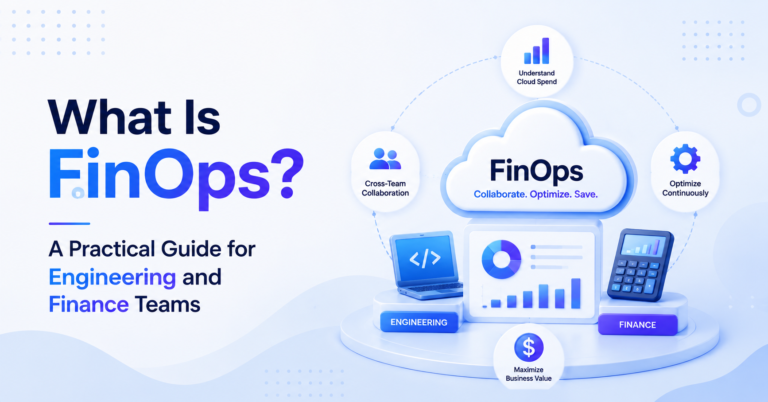
What is FinOps? FinOps is the operating model that brings engineering, finance, and business teams together to make trade-off decisions about cloud spend, in real time, using shared data instead of end-of-quarter reconciliation. It isn’t a tool, a job title, or a one-time cost-cutting initiative — it’s a recurring practice that makes cloud cost as visible to engineering as latency or error rate already are.
Table of Contents
Why Finance and Engineering Need a Shared Answer to “What Is FinOps”
Before getting into what FinOps solves, look at the gap it closes: Finance sees a $340,000 AWS invoice. Engineering sees 2,000 microservices, 40 teams, and no way to explain which line item belongs to whom. That gap — between a number finance has to justify and a system engineering has to run — is the exact problem FinOps was built to close.
The Definition of FinOps That Actually Matters
The FinOps Foundation defines it as a cultural practice that brings financial accountability to the variable spend model of cloud. In practice, understanding what FinOps means for an organization comes down to three shifts:
- Spend becomes visible to the people creating it. An engineer provisioning a database sees the cost impact, not just finance three weeks later.
- Decisions move from centralized cost-cutting to distributed cost-awareness. Instead of one team policing everyone’s spend, every team owns its own.
- Cloud cost becomes a real-time input to engineering decisions, the same way latency or error rate already is.
What Is FinOps in Practice? The Three Phases of the Cycle
FinOps runs as an iterative cycle, not a one-time project:
- Inform — Give every team accurate, allocated visibility into what they’re spending, broken down by service, environment, and owner. This is impossible without consistent tagging and a unified view across cloud providers.
- Optimize — Identify rightsizing opportunities, commitment discounts, and architectural changes that reduce cost without reducing capability. This is where FinOps overlaps with engineering roadmaps.
- Operate — Build the cost accountability into ongoing processes: budget alerts, showback/chargeback reporting, and cost reviews that happen monthly, not annually.
Teams that treat FinOps as a single audit (“let’s do a cost review this quarter”) get a temporary dip in spend and a slow drift back up. Teams that build Inform-Optimize-Operate into a recurring cycle keep the savings.
Why Engineering and Finance Read FinOps Data Differently
Finance wants to know: what will we spend next quarter, and can we defend it to the board? Engineering wants to know: is this service costing more than it should for what it does?
Both questions need the same underlying data — allocated, tagged, real-time cost data — but different views of it. A FinOps practice that only serves finance produces dashboards engineers ignore. A FinOps practice that only serves engineering produces optimization wins finance can’t translate into forecasts. The practical answer is to build one source of truth and let each team query it differently, not maintain two separate cost tracking systems that never reconcile.
How to Start a FinOps Practice Without a Dedicated Team
Most companies don’t have headcount for a standalone FinOps team on day one. That’s fine — FinOps as a practice can start with:
- One person (often a platform or DevOps lead) owning tagging standards and cost visibility.
- A monthly cost review with engineering leads and finance in the same room, looking at the same numbers.
- Budget alerts on the accounts or services most likely to spike, so surprises get caught in days, not at month-end billing.
That’s really what FinOps looks like in its earliest form — one person, one recurring review, one shared number, closely mirroring the Crawl-Walk-Run maturity model the FinOps Foundation recommends for teams just getting started.
The tooling matters here because manual tagging audits and spreadsheet reconciliation don’t scale past a handful of accounts. CloudPi, a multi-cloud cost management and governance platform, gives engineering and finance the same real-time, allocated view of cloud spend across AWS, Azure, and GCP — so the FinOps cycle runs on live data instead of last month’s invoice. For teams deciding between platforms to run this cycle on, see CloudPi vs CloudHealth, and for the cost-cutting side of the same practice, see how to reduce cloud costs by 30%.
Frequently Asked Questions
What is FinOps in simple terms?
FinOps is the practice of bringing engineering, finance, and business teams together to manage cloud spend collaboratively, using shared real-time data instead of finance reconciling costs after the fact.
What are the three phases of FinOps?
Inform, Optimize, and Operate — give teams accurate cost visibility first, identify savings opportunities second, then build cost accountability into recurring processes like budget alerts and monthly reviews.
Do you need a dedicated FinOps team to get started?
No. Most organizations start with one person — often a platform or DevOps lead — owning tagging standards and running a monthly cost review with engineering and finance in the same room.
What is FinOps compared to plain cost-cutting?
Cost-cutting is a one-time event that tends to drift back up; FinOps is a recurring cycle that keeps spend visible and accountable on an ongoing basis, which is what makes the savings stick.
Why do finance and engineering see cloud costs differently?
Finance needs forecastable, defensible numbers for the business; engineering needs to know if a specific service is costing more than it should. Both need the same allocated, tagged data — just different views of it.
View comments (2)