What Is FinOps, and How Does It Help?
FinOps, short for Financial Operations, is a practice that combines financial management with cloud operations to optimize cloud spending. This approach aims to bring financial accountability to the variable spend model of cloud services.
Importance of building a FinOps team:
- Cost Control: A dedicated FinOps team ensures effective monitoring and management of cloud costs, which involves thorough cost analysis.
- Optimization: The team identifies opportunities for cost savings and implements strategies to reduce unnecessary expenditure, often involving performance improvement measures.
- Transparency: Provides clear visibility into cloud spending, enabling better forecasting and budgeting.
Role of a Cloud Architect in FinOps team creation:
- Strategic Planning: Cloud architects design the architecture that aligns with both technical requirements and financial constraints.
- Implementation Guidance: They assist in integrating tools and processes that support FinOps principles, such as using Datadog for performance monitoring.
- Cross-functional Collaboration: Cloud architects facilitate communication between IT, finance, and business teams to ensure cohesive efforts in managing cloud costs.
In addition to these roles, cloud architects also play a crucial part in the cloud migration process, ensuring that the transition is smooth and cost-effective.
How to Define Clear Goals Through a FinOps Charter?
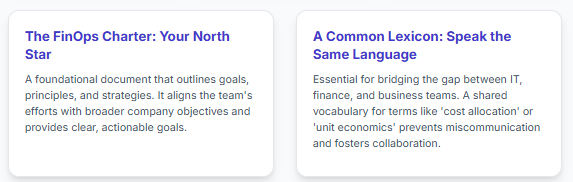
A FinOps charter is an important document that outlines the goals, principles, and strategies for managing cloud financial operations. Its purpose is to provide clear and actionable goals that align with broader organizational objectives.
Key aspects of a FinOps charter
- Purpose of a FinOps Charter: Establishes the framework for cloud cost management, ensuring all team members understand their roles and responsibilities in achieving financial efficiency.
- Aligning Goals with Organizational Objectives: Ensures the FinOps team’s efforts are in sync with the company’s strategic priorities, such as cost reduction, resource optimization, and value creation from cloud investments.
- Importance of Clarity in Goal-Setting: Clear goals eliminate ambiguity, allowing team members to focus on specific outcomes, measure progress accurately, and adjust strategies as needed.
Creating a FinOps charter with well-defined goals is crucial for driving effective cloud cost management and achieving long-term success. This process can also benefit from leveraging cloud automation strategies which can streamline operations and enhance efficiency.
Why Developing a Common Lexicon for Consistent Communication Is Important?
A common lexicon is essential for effective communication within any FinOps team. Cloud cost management involves finance, engineering, and operations, with each discipline using its own terminology and assumptions. Misunderstandings can occur if terms like reserved instances, cost allocation, or unit economics are understood differently across departments.
Benefits of a Common Lexicon
- Consistent communication: All stakeholders, regardless of their background, will understand key metrics, requirements, and priorities. This shared vocabulary reduces ambiguity in reporting and decision-making, making it easier to identify optimization opportunities or address budget concerns.
- Cross-functional collaboration: Standardized language benefits cross-functional teams. Engineers can align their resource usage with financial objectives, finance professionals gain confidence in the technical explanations behind cost drivers, and operations teams can facilitate process improvements more easily. The outcome is a unified approach to cloud spending, where collaboration is not obstructed by jargon or miscommunication.
Establishing and maintaining this lexicon should be an ongoing effort, supported by documentation and regular cross-team discussions.
What Are the Key Performance Indicators (KPIs) That Matter for Your Cloud Cost Management Strategy?
Identifying and tracking key performance indicators (KPIs) is foundational for measuring the effectiveness of a FinOps team. KPIs provide objective metrics to evaluate progress toward both cost efficiency and operational excellence in cloud environments.
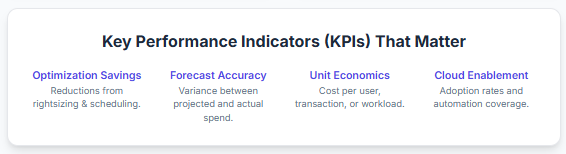
Critical KPIs for a FinOps function often include:
- Cloud enablement metrics: Adoption rates of cloud services, automation coverage, and self-service provisioning speed.
- Optimization savings: Quantifiable cost reductions achieved through rightsizing, reserved instance utilization, or workload scheduling.
- Forecast accuracy: The variance between projected and actual cloud spending, highlighting how well budget planning aligns with real-world consumption.
- Unit economics: Cost per user, transaction, or workload, enabling teams to compare efficiency across business units.
Regular monitoring of these metrics drives accountability and continuous improvement. Dashboards and automated reporting can reveal trends early, supporting timely interventions to avoid budget overruns or resource waste. Building a FinOps Team around data-driven KPIs ensures that every decision is grounded in measurable outcomes rather than intuition.
For instance, leveraging FinOps through platforms like CloudPi can significantly enhance your cloud efficiency. Additionally, understanding multi-cloud insights can provide valuable information for optimizing your cloud strategy. Implementing effective cost-saving tips is also crucial in achieving your financial objectives within the cloud environment.
How to Select Cost-effective Tools That Scale With Your Team’s Needs?
Selecting scalable tools for cost-effective solutions is critical when building a FinOps team. The right technology stack allows teams to automate analysis, optimize cloud usage, and manage costs effectively as the organization grows.
Key criteria for selecting FinOps tools include:
- Scalability: Tools must handle increasing data volumes and user counts without performance issues.
- Cost transparency: Solutions should provide clear insight into spending by project, team, or department.
- Automation capabilities: Automated reporting, anomaly detection, and policy enforcement reduce manual effort and human error.
- Customizability: Ability to tailor dashboards, alerts, and workflows to fit unique business needs.
- Vendor support and community: Responsive support channels and a strong user community enhance long-term tool value.
Integration with existing systems also plays a pivotal role. Effective FinOps tools should seamlessly connect with current cloud providers, financial systems, CI/CD pipelines, and identity management platforms. This connectivity ensures data consistency and minimizes disruption to operational workflows.
Moreover, understanding API integration is essential. A cost-benefit analysis of different API integration tools can help in making informed decisions about which solution best meets your team’s needs.
Tool selection decisions benefit from input across engineering, finance, and operations to ensure alignment with both technical requirements and business objectives. As part of this process, it’s important to consider strategies for transforming multi-tech giants into streamlined operations.
Additionally, managing multi-cloud costs effectively requires the right tools that offer cloud resource rightsizing features. Implementing effective cloud tagging strategies can also enhance cost transparency and optimization efforts. These strategies are essential for harnessing the power of tagging in achieving effective cloud resource management.
Why Ensuring Diverse Skills Within the Team Is Crucial?
A FinOps team thrives when equipped with a broad spectrum of expertise. Effective cloud cost management is not solely a technical challenge; it requires input from finance, operations, engineering, and procurement. Financial acumen within the team enables accurate forecasting, budgeting, and cost allocation, while technical proficiency ensures efficient cloud resource utilization.
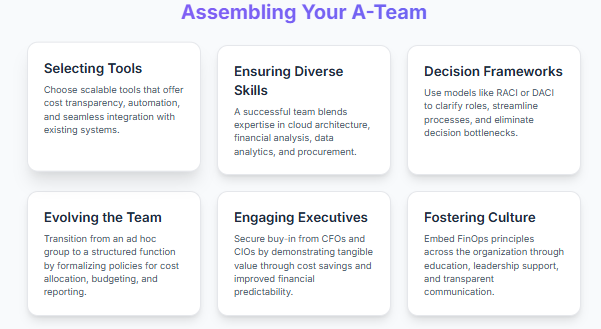
Key skill sets essential in a FinOps team include:
- Cloud architecture: Deep understanding of cloud platforms and services to identify optimization opportunities.
- Financial analysis: Ability to interpret invoices, forecast spend, and align budgets with business priorities. This is particularly important as cloud billing can be complex and requires specialized knowledge for effective management.
- Data analytics: Skills to extract insights from usage patterns and cost data for actionable recommendations.
- Procurement and vendor management: Negotiating contracts and managing relationships with cloud providers.
- Operations management: Coordinating workflows, governance, and compliance across teams.
A well-rounded team leverages each perspective to break down silos between technology and finance, encouraging holistic decision-making for sustainable cloud efficiency. This multidisciplinary approach reduces blind spots and fosters accountability across departments. Furthermore, with the right cloud savings strategies, the team can ensure that every dollar spent on cloud resources is optimized for maximum value.
In addition to these roles, it’s also vital to have a test manager for cloud in the team. This role plays a crucial part in ensuring high availability of services which is a key aspect of cost-effective cloud management.
How Decision-making Frameworks Can Streamline Your Team’s Processes
When building a FinOps team, clear decision-making frameworks like RACI (Responsible, Accountable, Consulted, Informed) and DACI (Driver, Approver, Contributor, Informed) are essential. These models provide explicit guidance on who owns which tasks and who needs to be consulted or informed throughout the process.
Clarifying Roles and Responsibilities
By designating specific roles—such as cloud architects, finance leads, and engineering managers—each team member understands their level of accountability. For example, in a RACI matrix, the cloud architect may be responsible for implementing cost optimization measures, while finance is accountable for budget adherence.
Streamlining Decision-Making Processes
Using these frameworks helps prevent bottlenecks by ensuring decisions do not stall due to unclear authority. Approvals for cloud spending changes or resource reallocations can be routed efficiently when responsibilities are pre-defined.
Applying structured decision-making models minimizes confusion and accelerates consensus, enabling the FinOps team to act with agility as cloud environments evolve.
How to Evolve Your Team Structure Over Time for Optimal Performance?
Transitioning from Ad Hoc to Structured Team Functions
Developing a FinOps team often begins with an ad hoc assembly of individuals pulled from various departments to address immediate cloud cost challenges. This initial phase is crucial for identifying key pain points and potential areas for improvement.
Implementing Policies and Procedures for Efficient Operations
Moving from an ad hoc assembly to a mature function requires the establishment of clear policies and procedures. These guidelines should cover:
- Cost Allocation: Define how costs are attributed to different departments or projects.
- Budget Management: Implement processes for setting, monitoring, and adjusting budgets.
- Reporting: Create standardized reporting formats for consistent tracking of cloud expenditures.
By formalizing these elements, the team can transition into a more structured and efficient function, capable of providing sustained value through optimized cloud spending. This shift not only streamlines operations but also significantly enhances cloud performance, leading to better resource utilization and cost savings.
Why Engaging Executives in the FinOps Process Is Essential?
Involving Key Executives in FinOps Initiatives
Engagement from key executives such as CFOs and CIOs is critical in driving the success of FinOps initiatives. Their involvement ensures that financial decision-making aligns with organizational goals and that cloud cost management is integrated into the broader business strategy. Executives possess a unique vantage point, enabling them to facilitate cross-departmental collaboration and resource allocation.
Demonstrating Value to Organizational Leadership
To secure executive buy-in, it’s important to demonstrate the tangible value that FinOps brings to the organization. This includes showcasing cost savings, improved efficiency, and enhanced financial predictability. Providing clear metrics and reports that highlight these benefits can help in making a compelling case for ongoing support and investment in FinOps practices.
By fostering executive engagement, organizations can ensure that FinOps principles are prioritized at all levels, promoting a culture of cost awareness and accountability across teams.
What Organizational Models Work Best for Your FinOps Team?
Choosing the right organizational structure for your FinOps team is crucial to its success. The decision often depends on the size and complexity of your organization. Two primary models are commonly considered:
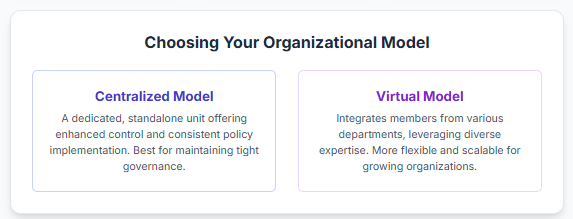
1. Centralized Model
A centralized FinOps team operates as a standalone unit within the organization.
Advantages:
- Enhanced control over cloud cost management processes.
- Consistent implementation of policies and procedures.
- Easier to maintain compliance and governance standards.
Disadvantages:
- Potential bottlenecks due to centralized decision-making.
- May struggle with scalability in large organizations.
2. Virtual Model
A virtual FinOps team integrates members from various departments, working collaboratively.
Advantages:
- Leverages diverse expertise from different functional areas.
- Enhances cross-departmental communication and collaboration.
- More flexible and scalable as the organization grows.
Disadvantages:
- Requires robust communication channels to function effectively.
- Potential for inconsistent application of FinOps practices.
When building a FinOps team, consider your organization’s specific needs, including scale, complexity, and existing infrastructure, to determine which model aligns best with your goals.
How to Foster Cultural Adoption of FinOps Practices Across Your Organization?
Achieving continuous cultural adoption of FinOps practices is crucial for sustainable cost management. This starts with aligning the organization’s culture with FinOps principles, making sure every team member understands the importance of cost efficiency and financial accountability in cloud operations.
1. Education and Training
Regular workshops and training sessions can help spread FinOps principles across all levels of the organization. These could include sessions on [cloud strategy](https://cloudpi.ai/blogs/tag/cloudstrategy) and [multi-cloud cost efficiency](https://cloudpi.ai/blogs/tag/multi-cloud-cost-efficiency).
2. Leadership Buy-In
When executives support FinOps practices, it sets a tone that resonates throughout the company.
3. Transparent Communication
Open discussions about cloud spending, cost-saving opportunities, such as those identified through cloud spend analysis, and financial goals promote a culture of transparency and collective responsibility.
4. Reward Systems
Incentivizing teams for achieving cost-saving milestones can reinforce positive behavior towards cost management.
By embedding these practices into the organizational culture, businesses can achieve long-term success in their cloud cost management strategies. For example, one specific area where significant savings can be achieved is in managing Amazon S3 costs. Implementing strategies to reduce Amazon S3 costs by minimizing GET requests can be a practical example of how FinOps principles can lead to tangible financial benefits.
Conclusion
Building a FinOps Team requires a strategic mix of technical skills, collaborative culture, and clear operational frameworks. Successful teams consistently align financial goals with cloud operations, use data-driven KPIs, and promote open communication across departments. Putting emphasis on executive involvement and cultural acceptance enhances the effectiveness of FinOps practices. Organizations set up for long-term cloud cost management understand that team structure, skill diversity, and continuous improvement are essential in getting the most out of their cloud investments.