
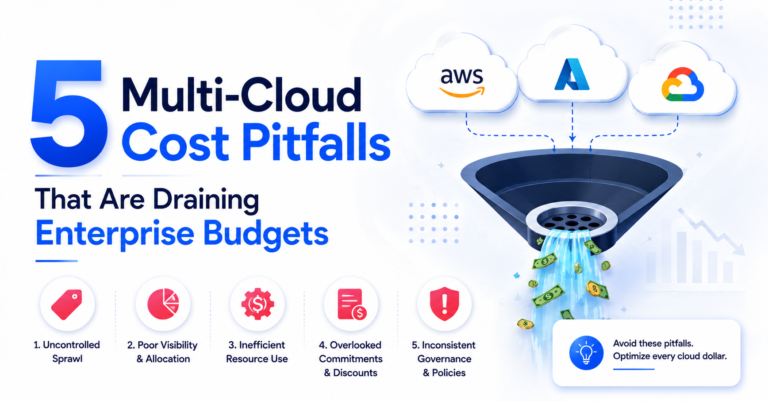
Multi-cloud strategies get evaluated for their architectural benefits — resilience, best-of-breed services, avoiding lock-in — but the multi-cloud cost pitfalls that actually drain enterprise budgets rarely get the same scrutiny. The cost structure multi-cloud creates by default tends to be worse than single-cloud unless someone actively manages against it. Here are the five patterns doing the most damage, in order of how much budget they typically consume.
Table of Contents
1. Cross-Cloud Egress Costs
Moving data from one provider to another isn’t free, and the costs scale with the volume of data moving, which grows as your product grows. A common architecture mistake: a data pipeline that reads from a database in one cloud and writes to an analytics platform in another, generating recurring cross-cloud egress costs that weren’t factored into the original architecture decision. This cost is invisible until you look for it specifically — it doesn’t appear as “egress” on most dashboards, just as elevated network charges buried in a larger bill.
The fix: Map data flows across cloud boundaries explicitly, and treat cross-cloud egress costs as an architecture decision with a real price tag, not a free byproduct of using “the right tool for the job.”
2. Duplicate Cloud Tooling Across Providers
Each platform team, working somewhat independently, tends to select its own monitoring, logging, security scanning, and CI/CD tooling optimized for their provider. Multiply this across three clouds and you often end up paying for three versions of the same capability. Duplicate cloud tooling is the single largest source of avoidable multi-cloud spend, because it’s organizational, not technical — nobody compared total tool spend across providers because nobody owned that comparison.
The fix: Review tooling spend at the organization level, not per-cloud, and consolidate onto multi-cloud-native tools where the functionality overlaps completely.
3. Losing Volume Discount Tiers
Committed-use discounts and enterprise agreements scale with total spend on a given provider. Splitting workloads across three clouds means never concentrating enough volume on any single provider to unlock the deepest volume discount tiers. A workload that could run at a 25% effective discount consolidated on one cloud might only reach a 10% discount split across two.
The fix: Where workload placement is flexible, consider consolidating volume on fewer providers even if it means a slightly less “optimal” per-service fit — the difference in volume discount tiers often outweighs the marginal service advantage.
4. Inconsistent Rightsizing Practices
Rightsizing discipline often varies significantly by cloud, usually correlating with which provider the platform team is most comfortable operating. A company might have mature rightsizing practices on AWS after years of experience, while their newer Azure footprint runs oversized by default because nobody has built the same operational muscle there yet.
The fix: Apply rightsizing analysis consistently across all providers, not just the one your team knows best — the newest cloud in your stack is usually where the most waste is hiding. See the cloud cost optimization checklist for the tactical steps behind this.
5. No Single Owner for Total Multi-Cloud Spend
This is the root cause behind the other four multi-cloud cost pitfalls. When each cloud has its own platform team and its own budget line, nobody is incentivized to look at total spend across all three, compare tooling, or catch cross-cloud duplication. The org chart mirrors the cloud sprawl instead of managing it. Weak cloud cost ownership is what lets the first four pitfalls compound for years without anyone catching them.
The fix: Assign explicit cloud cost ownership for total multi-cloud spend — someone whose job includes comparing spend and tooling across providers, not just optimizing within one. See the multi-cloud governance guide for how to structure that ownership formally, and multi-cloud vs single cloud if you’re still deciding whether the complexity is worth taking on at all.
Seeing All Five Multi-Cloud Cost Pitfalls at Once
Each of these pitfalls is individually manageable. What makes them expensive at scale is that they compound silently across three separate billing systems that nobody is comparing side by side. CloudPi, a multi-cloud cost management and governance platform, consolidates spend, tagging, and tooling visibility across AWS, Azure, and GCP into one view — so these five multi-cloud cost pitfalls show up as line items to fix, not invisible drag on an enterprise budget.
Frequently Asked Questions
What are the most common multi-cloud cost pitfalls?
Cross-cloud egress costs from data moving between providers, duplicate cloud tooling purchased separately per cloud, lost volume discount tiers from splitting spend across providers, inconsistent rightsizing practices, and no single owner responsible for total multi-cloud spend.
Why is duplicate cloud tooling the most expensive pitfall?
Because it’s organizational rather than technical — each platform team optimizes tooling for their own provider independently, and nobody compares total tool spend across all three clouds because nobody owns that comparison.
How do volume discount tiers get lost in a multi-cloud setup?
Committed-use discounts and enterprise agreements scale with total spend on a given provider. Splitting workloads across three clouds means never concentrating enough volume on any single provider to reach the deepest discount tier.
Why does rightsizing discipline vary between cloud providers at the same company?
It usually correlates with which provider the platform team has the most operational experience with — a newer cloud in the stack often runs oversized by default simply because the team hasn’t built the same rightsizing habits there yet.
What’s the root cause behind most multi-cloud cost pitfalls?
Lack of a single owner for total multi-cloud spend. When each cloud has its own platform team and budget line, nobody is incentivized to compare spend, tooling, or catch duplication across providers.