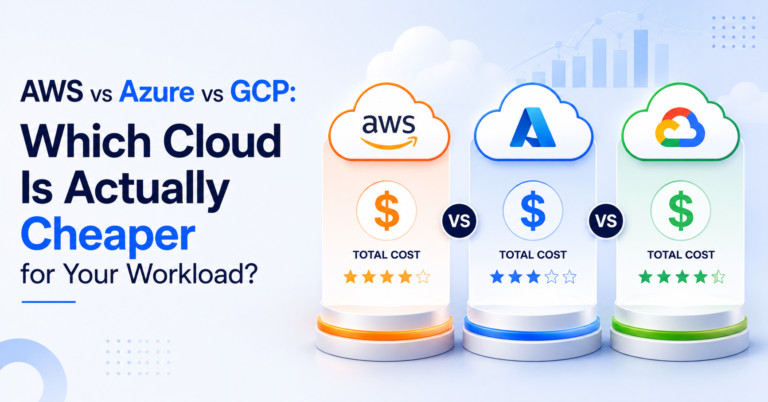
“Which cloud is cheapest” is the wrong question for an AWS vs Azure vs GCP cost comparison, and it’s why so many of them end up useless. The right question is which cloud is cheapest for your specific workload shape — because the pricing gap between providers can flip by 20–40% depending on whether you’re comparing steady-state compute, bursty batch jobs, or data-heavy analytics. Here’s how the cloud pricing comparison actually breaks down, by workload type rather than by provider.
Table of Contents
AWS vs Azure vs GCP Cost for Steady-State Compute
For predictable, always-on workloads, the comparison comes down to committed use discounts rather than on-demand rates, since almost nobody runs steady-state compute at on-demand pricing.
| AWS | Azure | GCP | |
|---|---|---|---|
| Discount model | Savings Plans | Reserved Instances | Sustained-use (automatic) + Committed-use |
| Flexibility | High — flexible across instance families and regions | Lower — less flexible to switch instance types mid-term | High — sustained-use applies automatically, no upfront commitment needed |
| Best for | Fleets whose instance composition changes over time | Predictable, long-term stable workloads willing to commit upfront | Teams that want a competitive rate without a procurement process |
| Effective rate after discounts | Competitive, close to GCP | Typically requires a longer or larger commitment to match | Often the simplest path to a low effective rate |
For workloads that run 24/7 with a predictable shape, GCP and AWS tend to land closest together after discounts are applied; Azure typically requires a longer or larger commitment to reach the same effective rate.
AWS vs Azure vs GCP Cost for Bursty and Batch Workloads
Spot instance pricing is where the providers diverge most:
| AWS Spot | GCP Preemptible/Spot | Azure Spot | |
|---|---|---|---|
| Market depth | Deepest and most liquid | Competitive | Least mature of the three |
| Interruption handling | Requires careful handling | More predictable interruption notice | Less consistent availability across regions |
| Typical fit | Fault-tolerant batch workloads chasing the deepest discount | Workloads that want lower engineering overhead around interruptions | Workloads with more availability flexibility |
For workloads that can tolerate interruption, AWS or GCP spot pricing usually wins over Azure on both cost and reliability of the discount.
Storage, Cloud Egress Costs, and Data Transfer
This is where an AWS vs Azure vs GCP cost comparison surprises people most — compute pricing gets all the attention, but cloud egress costs and storage tiering often decide the real winner:
- All three providers charge for egress, but the free tiers and pricing tiers differ enough that a data-heavy workload can see meaningfully different bills depending on provider.
- GCP’s network pricing has historically been more transparent with fewer regional pricing tiers to navigate.
- AWS and Azure both offer cheaper storage classes for cold data, but the retrieval costs and minimum storage durations differ enough to change the effective cost for workloads with unpredictable access patterns.
Why the “Cheapest Cloud Provider” Answer Changes Every Year
Provider pricing changes frequently, and discount structures get revised. A comparison that was accurate a year ago may not hold today – there is no single cheapest cloud provider that stays true across workload types or stays fixed year over year. The workloads that benefit most from a rigorous comparison are the ones large enough that a 10-15% pricing gap translates into real budget impact – which is most workloads once they’re past the early-stage/testing phase.
The Only Reliable Way to Settle AWS vs Azure vs GCP Cost for Your Workload
Public pricing pages compare list prices. Your actual cost depends on your specific instance mix, commitment level, data transfer patterns, and discount eligibility – none of which a generic comparison article can calculate for you. For the tactical steps to apply once you know where your spend actually sits, see the cloud cost optimization checklist, and for the broader discipline this comparison feeds into, see multi-cloud cost management.
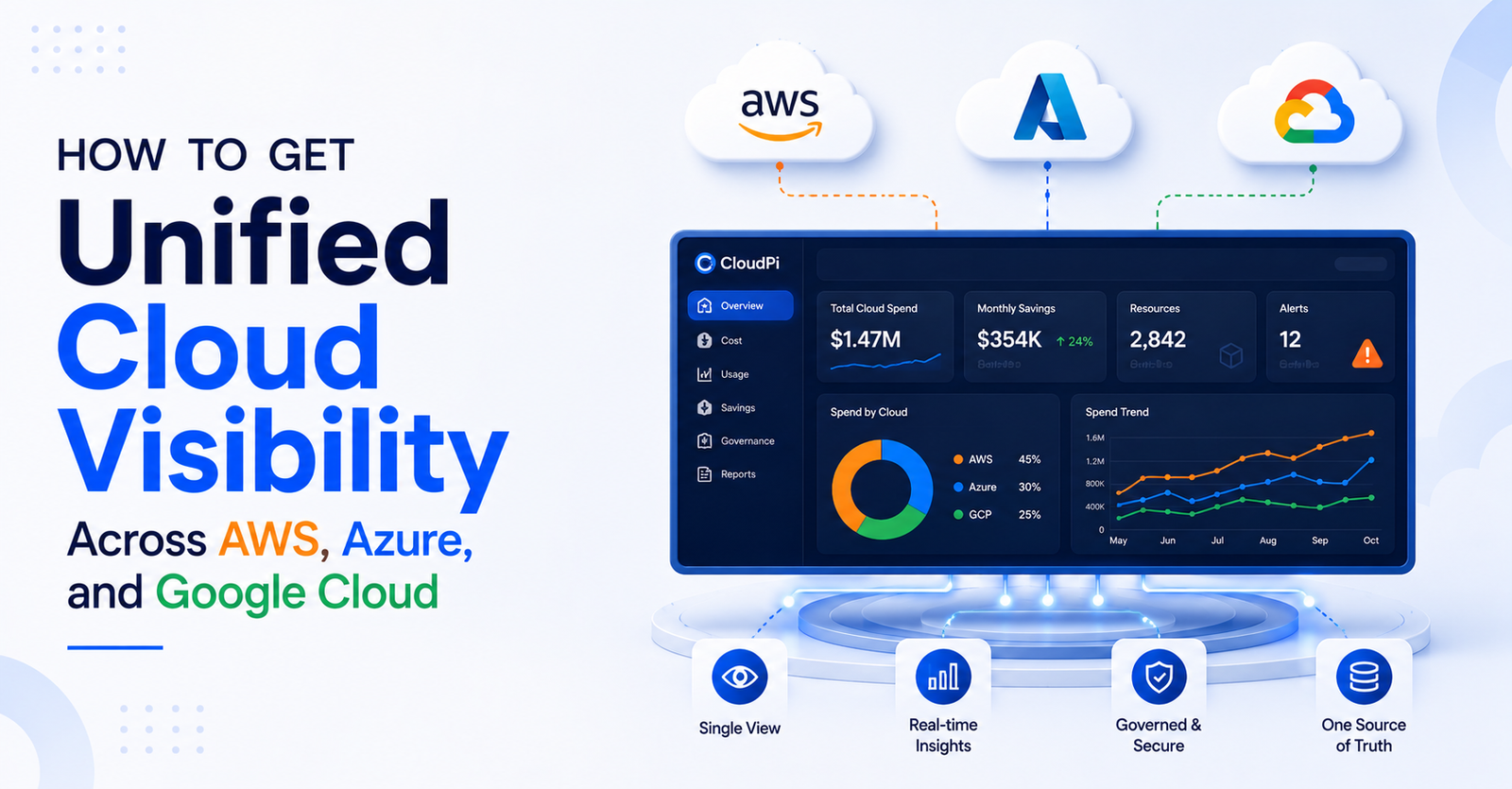
CloudPi, a multi-cloud cost management and governance platform, tracks real spend across AWS, Azure, and GCP side by side, so instead of guessing which provider is cheaper in the abstract, you can see exactly what an equivalent workload is costing you on each cloud you’re already running – and make the provider decision on your actual numbers.
Frequently Asked Questions
Which cloud is cheapest: AWS, Azure, or GCP?
There’s no single answer – the cheapest provider depends on workload shape. GCP and AWS tend to land closest together for steady-state compute after discounts, AWS or GCP usually win on spot/preemptible pricing, and storage/egress costs vary enough by provider to change the outcome for data-heavy workloads.
Which cloud has the best discount for steady-state, always-on workloads?
GCP’s sustained-use discounts apply automatically with no upfront commitment, and committed-use discounts stack on top, often making it the simplest path to a competitive rate without a procurement process.
Which cloud is cheapest for bursty or batch workloads?
AWS Spot Instances have the deepest and most liquid market, while GCP’s preemptible/spot VMs offer more predictable interruption notice; Azure Spot VMs are generally the least mature of the three options.
Do storage and egress costs matter as much as compute pricing in an AWS vs Azure vs GCP cost comparison?
Yes – egress and storage tiering often decide the real cost winner for data-heavy workloads, even though compute pricing gets most of the attention in typical comparisons.
How often does the AWS vs Azure vs GCP cost comparison change?
Frequently. Provider pricing and discount structures get revised regularly, so a comparison that was accurate a year ago may not hold today, especially for workloads large enough that a 10-15% pricing gap has real budget impact.