
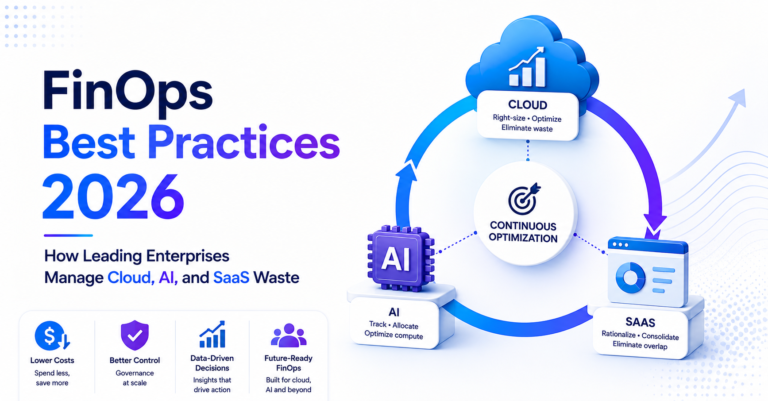
FinOps best practices 2026 look different from even a year ago. The discipline has expanded past public cloud into what practitioners call “Cloud+” — SaaS, licensing, private cloud, and data center spend — while AI cost management has gone from a niche concern to something nearly every FinOps practitioner now owns. The teams pulling ahead in 2026 aren’t just optimizing compute anymore; they’re governing cost at the design stage, standardizing data across a much wider technology estate, and proving that spend creates business value, not just cutting it.
Table of Contents
Why FinOps Best Practices 2026 Look Different From 2025
According to the FinOps Foundation’s sixth annual State of FinOps report, AI cost management has become nearly universal — 98% of respondents now manage AI spend, up from 63% just a few years earlier. At the same time, 90% of practices now manage SaaS spend and roughly six in ten manage private cloud and data center costs, a scope FinOps simply didn’t cover a year or two ago. This is the backdrop every practice needs to plan around going into 2026.
1. Extend FinOps Past Cloud Into “Cloud+”
FinOps in 2026 isn’t just an AWS, Azure, and GCP conversation anymore. Leading practices are broadening scope to include SaaS, licensing, data center, and AI spend, using shared data standards to keep it manageable. Treating SaaS and licensing spend as someone else’s problem is no longer realistic once nine out of ten FinOps teams are already responsible for it.
2. Build Real Governance Around AI and Inference Spend
AI workloads don’t behave like traditional compute — usage is volatile and harder to forecast, which is exactly why a leading cloud and AI engineering executive argues FinOps will become a core operating discipline rather than just a cost-optimization exercise as AI workloads introduce volatile, usage-based spend. Budget alerts sized for steady-state compute usually miss AI cost spikes entirely; anomaly thresholds need to be rebuilt around how inference and training workloads actually spend.
3. Adopt Shift-Left Cost Governance
One of the clearest FinOps best practices 2026 shifts is moving cost estimation earlier in the development lifecycle. Leading FinOps teams are adopting shift-left practices — estimating and governing infrastructure costs at the design and pull-request stage, rather than after resources are already running. Embedding a cost check into code review, alongside security and performance review, catches expensive architectural decisions before they ship instead of three months after the invoice lands.
4. Standardize on FOCUS Instead of Per-Vendor Cost Formats
Multi-cloud, multi-vendor cost data doesn’t reconcile cleanly on its own. The FinOps Open Cost and Usage Specification exists specifically to standardize cost and usage data so teams can report and allocate spend consistently across vendors and environments, and the FinOps Foundation now treats it as the underlying data standard that makes managing cost across cloud, SaaS, and AI tractable in one system rather than three incompatible ones.
5. Move From Cost Reviews to Real-Time Anomaly Detection
This fundamental still holds in 2026: a quarterly cost review only finds waste that’s already accumulated for three months. Mature programs replace the review cadence with real-time anomaly detection, catching a spend spike within hours instead of on the next invoice — and the FinOps Foundation found nearly half of practitioners now rate using AI for FinOps itself as highly important, largely for faster anomaly detection and automated rightsizing.
6. Secure Technology Leadership, Not Just Finance Buy-In
Where FinOps sits in the org has shifted materially. 78% of FinOps practices now report into the CTO/CIO organization, and practices with executive-level engagement show measurably more influence over technology decisions than those stuck at director level. A FinOps program pitched only to finance is increasingly out of step with how mature practices are actually structured.
7. Treat Commitment Discounts as a Living Portfolio
Reserved instances and savings plans bought once and left alone become a liability as workloads shift — including when a workload gets fully replaced and the old commitment quietly keeps billing. Leading enterprises review commitment coverage against current workload lifecycles on a set cadence, not just at renewal.
8. Measure Value Created, Not Just Cost Cut
Perhaps the biggest mindset shift among FinOps best practices 2026: mature practices are increasingly focused on unit economics and quantifying the value AI and technology spend creates, not simply reducing the bill. The goal is no longer “spend less” — it’s making every technology dollar a deliberate, measurable business decision. For the fundamentals this builds on, see what is FinOps, and for the tactical checklist to run alongside these practices, see the cloud cost optimization checklist.
Making These Practices Stick
Best practices only compound if the underlying data is accurate, current, and consistent across an expanding technology estate. CloudPi, a multi-cloud cost management and governance platform, gives enterprise FinOps teams real-time, allocated cost visibility, anomaly detection, and tagging enforcement across AWS, Azure, and GCP — the infrastructure layer these 2026 practices depend on as scope expands beyond cloud alone.
Frequently Asked Questions
What are the top FinOps best practices 2026?
Extending scope past cloud into SaaS and private cloud, building real governance around AI and inference spend, shifting cost estimation left into design and code review, standardizing on FOCUS for cross-vendor data, and measuring value created rather than just cost cut.
Why has AI cost management become a core part of FinOps best practices 2026?
Because AI spend has gone from a niche concern to something nearly every FinOps practitioner manages — usage-based and volatile in a way traditional compute budgeting wasn’t built to handle.
What does “shift-left” mean in FinOps?
Estimating and governing infrastructure costs at the design and pull-request stage, before resources are provisioned, rather than discovering the cost impact after a service is already running.
Why does FOCUS matter for FinOps in 2026?
It standardizes cost and usage data across different vendors and technology categories, so teams can allocate and report spend consistently instead of reconciling incompatible formats from cloud, SaaS, and AI providers separately.
Is FinOps still just about cutting cloud costs?
No. Mature practices in 2026 increasingly treat FinOps as a value-management discipline — measuring the business value technology spend creates — rather than a pure cost-reduction exercise.