
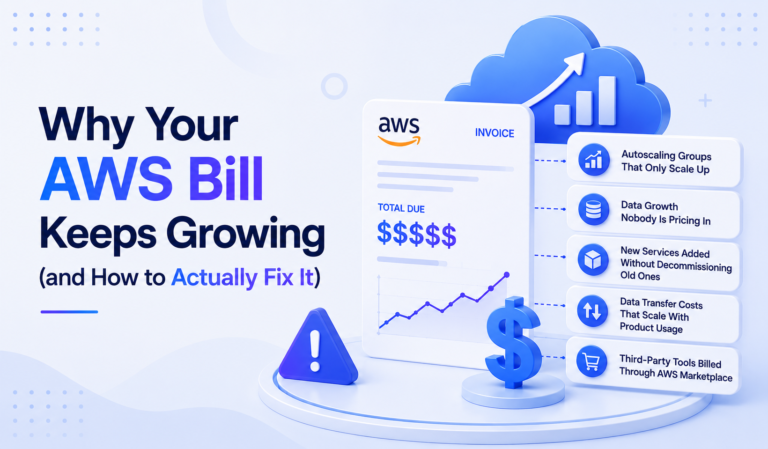
If your AWS bill is too high and nobody added a major feature, it’s almost never one cause. It’s usually four or five small things compounding at once, each too small to notice on its own: autoscaling minimums that never reset, data retention nobody’s pricing in, old services left running after a migration, data transfer that scales quietly with usage, and third-party tools billed through AWS Marketplace. Here’s where the growth actually comes from, in the order it’s usually worth checking.
Table of Contents
Why an AWS Bill Too High to Explain Almost Never Has One Cause
The AWS invoice went up again this month, nobody added a major new feature, and finance is asking why. An AWS bill too high to explain with a single line item is the most common support ticket in FinOps, and it almost never has a single cause.
1. Autoscaling Groups That Only Scale Up
Autoscaling is designed to add capacity under load. It’s not always designed to remove it cleanly. Scale-in policies with conservative cooldowns, or minimum instance counts set during a traffic spike and never reset, keep baseline capacity higher than current demand requires. Check your ASG minimums against last month’s actual low-traffic utilization — not the number someone set eighteen months ago. AWS’s own autoscaling documentation recommends revisiting scale-in policies on a recurring basis for exactly this reason.
2. Data Growth Nobody Is Pricing In
Storage costs scale with data volume, and data volume only grows. Logs, backups, and snapshots accumulate quietly, and most retention policies are set once and forgotten. A CloudWatch Logs group with no retention limit will store data indefinitely at full price. Multiply that across every service, and log storage alone can become a five-figure monthly line item with no one workload responsible for it.
3. New Services Added Without Decommissioning Old Ones
Migrations rarely happen cleanly. A team moves a workload to a new RDS instance and the old one stays running “just in case” for a rollback that never happens. Three months later, you’re paying for both. This is the single most common source of silent bill growth in companies that ship fast — the removal step gets deprioritized because nothing is broken.
4. Data Transfer Costs That Scale With Product Usage
If your product is growing, your data transfer costs grow with it — and this is often invisible because it’s usage-based, not provisioned. Cross-region replication, CDN origin fetches, and API calls between services in different availability zones all bill per gigabyte. Unlike compute, there’s no single dashboard most teams check for this, so it grows unnoticed until it’s the second- or third-largest line item.
5. Third-Party Tools Billed Through AWS Marketplace
SaaS tools purchased through AWS Marketplace show up on the AWS bill, not as a separate subscription line. If your AWS bill is too high and infrastructure usage hasn’t changed, check Marketplace subscriptions before anything else — teams reviewing “AWS cost” often don’t realize a chunk of the increase is a marketplace subscription that renewed or scaled with usage, not infrastructure at all.
How to Fix an AWS Bill That’s Too High, Not Just Explain It
Explaining an AWS bill that’s too high to finance is a one-time fix. Preventing the next one requires:
- Monthly, not quarterly, cost reviews — growth compounds between reviews, so the gap between checks determines how much waste accumulates before anyone notices.
- Retention policies enforced at the account level, not left to individual teams to configure per service.
- Decommissioning checklists tied to every migration, so “temporarily keep the old one running” has a hard expiration date.
- Anomaly detection on spend, not just budget thresholds. A budget alert fires after you’ve already overspent for the month. Anomaly detection catches the trend while it’s still small.
For the full sequence on cutting spend once you’ve found where it’s going, see how to reduce cloud costs by 30%, and for the week-by-week list to work through these fixes, see the cloud cost optimization checklist.
Seeing the Growth Before Finance Does
The reason “why is my AWS bill too high” keeps coming up is that most teams find out about bill growth from the invoice, after the spend already happened. CloudPi, a multi-cloud cost management and governance platform, tracks spend trends and flags anomalies across AWS, Azure, and GCP as they happen, so the question gets answered in the first week of the month instead of after the invoice lands.
Frequently Asked Questions
Why is my AWS bill too high when I haven’t added any major features?
An AWS bill too high relative to your feature work is almost always several small things compounding at once — autoscaling minimums that never reset, data retention nobody’s pricing in, decommissioned services still running, and data transfer that scales quietly with product usage.
What’s the most common cause of a growing AWS bill?
Leaving old infrastructure running after a migration. A team moves a workload to a new instance, keeps the old one “just in case,” and three months later is paying for both with no one noticing.
How can I catch AWS bill growth before the invoice arrives?
Use anomaly detection on spend trends instead of relying only on budget thresholds. A budget alert fires after you’ve overspent for the month; anomaly detection catches the trend while it’s still small.
Do third-party tools affect my AWS bill?
Yes. SaaS tools purchased through AWS Marketplace bill through your AWS invoice rather than as a separate subscription, so a bill increase can come from a marketplace renewal rather than infrastructure growth.
How often should I review AWS costs to prevent the bill from creeping up?
Monthly, not quarterly. Growth compounds in the gap between reviews, so shorter review cycles catch waste while it’s still small and cheap to fix.