
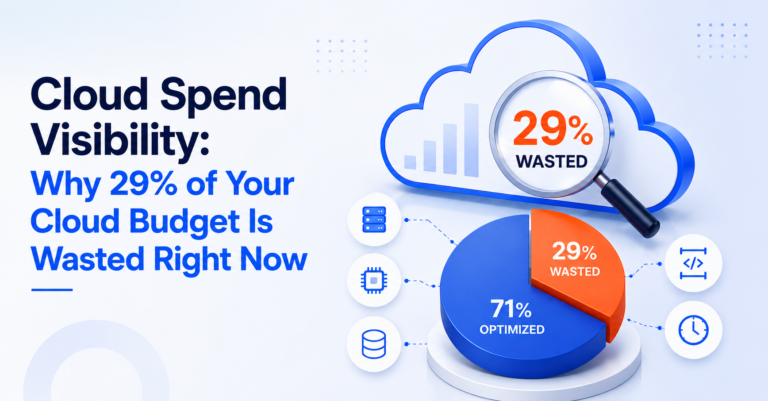
Poor cloud spend visibility, not lack of intent, is why cloud waste is rising again after years of improvement. Flexera’s 2026 State of the Cloud Report found wasted cloud spend ticked up to 29% of IaaS/PaaS budget — the first increase in five years, driven largely by the cost complexity AI workloads and new PaaS/SaaS offerings introduce. Most teams already know they’re wasting money — what they lack is granular, real-time cloud spend visibility down to the team and service level, which is the actual bottleneck, not effort or intent.
Table of Contents
Why “We Know We’re Wasting Money” Isn’t the Same as Cloud Spend Visibility
Almost every engineering leader will tell you their cloud spend has waste in it. Very few can tell you exactly where, in dollar terms, broken down by team and service, updated this week. That gap between general awareness and specific, actionable cloud spend visibility is where the 29% hides.
Waste isn’t usually one dramatic mistake — a forgotten $50,000/month cluster is rare and gets found fast because it’s big enough to notice. The real 29% is distributed across thousands of small gaps: an oversized instance here, an idle load balancer there, a storage bucket on the wrong tier, none of them individually alarming, all of them invisible without granular, allocated tracking.
The Three Gaps That Block Cloud Spend Visibility
Allocation gaps. If 20% of your resources are untagged or inconsistently tagged, 20% of your spend can’t be attributed to a team or service. Nobody owns fixing what nobody can see they’re responsible for.
Timing gaps. Native cloud billing dashboards often lag actual usage by 24–48 hours, and monthly invoices lag further. By the time waste shows up on a report, it’s already been running — and billing — for weeks.
Cross-cloud gaps. Teams running AWS, Azure, and GCP simultaneously usually view each provider’s spend through that provider’s own console. Waste that only becomes visible in aggregate — like duplicate tooling across clouds, or workloads that could consolidate — never shows up because no single view exists.
What Real Cloud Spend Visibility Actually Looks Like
Real cloud spend visibility means being able to answer, at any moment: what is each team spending, on what, is it trending up or down, and why. That requires:
- Allocation to the owner level, not just the account level — knowing “AWS costs $200K/month” tells you nothing actionable; knowing “the payments team’s staging environment costs $18K/month and grew 40% this quarter” does.
- Near-real-time data, not month-end reconciliation, so waste is caught while it’s still small.
- A unified view across cloud providers, so cross-cloud patterns and duplication become visible instead of hidden in separate consoles.
For the tactical steps that follow once visibility exists, see the cloud cost optimization checklist, and for the sequencing logic behind acting on what you find, see how to reduce cloud costs by 30%.
Closing the Cloud Spend Visibility Gap
The 29% number isn’t a law of nature — it’s a symptom of billing systems built for invoicing, not for operational decision-making. Teams that build real allocation and real-time cloud spend visibility routinely bring waste down to single digits, not because they work harder, but because they can finally see what needs fixing.
CloudPi, a multi-cloud cost management and governance platform, was built around this exact gap: allocated, real-time cloud spend visibility across AWS, Azure, and GCP, broken down to the team and service level, so the waste inside your 29% stops being a statistic and becomes a list you can act on this week.
Frequently Asked Questions
Why is cloud spend visibility such a persistent problem?
Because native billing dashboards lag actual usage by 24–48 hours or more, resources are often inconsistently tagged, and teams running multiple cloud providers each view spend through separate consoles — none of which gives a real-time, allocated picture.
How much of a typical cloud budget is wasted?
Flexera’s 2026 State of the Cloud Report put wasted cloud spend at 29% of IaaS/PaaS budget — the first uptick in five years, after a period of steady improvement, driven largely by rising AI workload complexity.
What’s the difference between knowing you’re wasting money and having cloud spend visibility?
Knowing there’s waste is general awareness; visibility means being able to name the exact dollar amount, team, and service responsible for it, updated within days rather than at month-end.
What are the three biggest gaps that block cloud spend visibility?
Allocation gaps from inconsistent tagging, timing gaps from billing dashboards that lag actual usage, and cross-cloud gaps from viewing each provider’s spend through a separate console instead of one unified view.
Can cloud spend visibility alone reduce waste, or is more needed?
Visibility is the prerequisite, not the whole fix — but teams that achieve real, granular, real-time visibility routinely bring waste down to single digits because they can finally see specifically what needs fixing.