
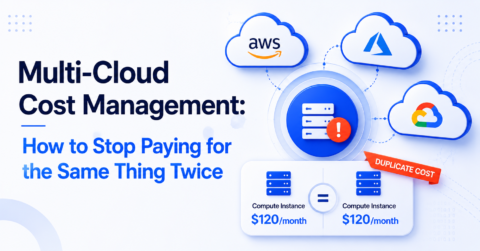
The hardest problem in multi-cloud cost management isn’t overspending within a single cloud — it’s duplicating spend across clouds because no one has multi-cloud cost visibility to catch it. A company running workloads on both AWS and Azure once discovered they were paying for two separate observability stacks, two separate CDN configurations, and two separate backup solutions — one per cloud — because each platform team had independently solved the same problem for their provider. The fix wasn’t cutting either team’s budget; it was consolidating onto one tool that worked across both clouds.
Table of Contents
Why Multi-Cloud Cost Management Is Harder Than Single-Cloud Spend
Running on multiple providers is usually a deliberate, reasonable decision — avoiding vendor lock-in, matching services to provider strengths, or meeting a customer’s infrastructure requirement. But the cost structure that results is harder to manage than single-cloud spend for three specific reasons:
- Duplicate tooling. Monitoring, logging, security scanning, and backup solutions often get selected independently per cloud, because each platform team optimizes for their provider rather than the organization’s total tool spend.
- Inconsistent tagging conventions. AWS, Azure, and GCP each have their own tagging/labeling systems, and teams rarely enforce the same taxonomy across all three. This makes consolidated cost allocation a manual, error-prone exercise.
- No single source of truth for total spend. Finance ends up reconciling three separate billing exports in a spreadsheet, which means the true picture of spend is always at least a month stale.
Where Multi-Cloud Cost Management Waste Actually Hides
Duplicate cloud tooling is the most expensive form this waste takes — it isn’t infrastructure, it’s SaaS and platform tooling licensed per cloud instead of once, organization-wide. Common patterns:
- Separate APM tools for AWS-hosted and Azure-hosted services when one tool supports both.
- Redundant CDN or WAF configurations purchased per provider instead of a single multi-cloud edge layer.
- Duplicate CI/CD runners or build infrastructure maintained separately per cloud environment.
Finding these requires comparing tool spend across providers side by side, not per-cloud line-item review — which is exactly the view most native billing consoles don’t offer.
Building a Single Source of Truth for Multi-Cloud Cost Management
The practical fix has three parts:
- Normalize tagging across providers. Cloud tagging normalization means mapping AWS tags, Azure tags, and GCP labels to one consistent taxonomy — owner, team, environment, cost center — so a report can group spend the same way regardless of which cloud generated it. This is the step that makes cross-cloud cost allocation possible in the first place.
- Consolidate billing data into one view, updated at the same cadence across all providers, not reconciled manually at month-end.
- Review tool spend at the organization level, not the cloud level. Ask “what are we paying for observability across all clouds” instead of “what is our AWS observability bill.”
Effective multi-cloud cost management also depends on the same rightsizing and idle-resource discipline that applies within a single cloud — see the cloud cost optimization checklist for the tactical steps, and what is FinOps for the operating model this fits inside.
The Payoff Beyond Cost
Multi-cloud cost visibility doesn’t just save money through cloud cost consolidation — it makes cross-cloud architecture decisions possible. You can’t decide whether a workload should move from AWS to GCP for cost reasons if you can’t compare true costs apples-to-apples in the first place. This is the part of multi-cloud cost management that pays for itself well beyond the initial tool consolidation.
CloudPi, a multi-cloud cost management and governance platform, normalizes cost and tagging data across AWS, Azure, and GCP into one dashboard, so duplicate spend across clouds becomes visible in the same place you already look for cost anomalies — not a separate spreadsheet reconciliation project.
Frequently Asked Questions
What is the biggest challenge in multi-cloud cost management?
Duplicated spend across providers — the same tooling category (observability, CDN, backups) purchased separately per cloud because no unified view exists to catch the overlap, rather than overspending within any single cloud.
Why is tagging harder in a multi-cloud environment?
AWS, Azure, and GCP each use their own tagging or labeling systems, and teams rarely enforce a consistent taxonomy across all three, which turns cost allocation into a manual, error-prone exercise instead of an automated report.
How do you find duplicate tooling spend across clouds?
By comparing tool spend at the organization level — “what are we paying for observability across all clouds” — instead of reviewing each cloud’s bill separately, since native billing consoles don’t show cross-cloud comparisons by default.
What’s the first step in fixing multi-cloud cost management problems?
Normalizing tagging across providers first — mapping AWS tags, Azure tags, and GCP labels to one consistent taxonomy for owner, team, environment, and cost center — since nothing else can be consolidated accurately until spend can be grouped the same way regardless of cloud.
Does multi-cloud cost management only save money, or does it help with other decisions too?
Both. Beyond cutting duplicate spend, having a true apples-to-apples cost comparison across providers is what makes decisions like migrating a workload from one cloud to another for cost reasons possible in the first place.